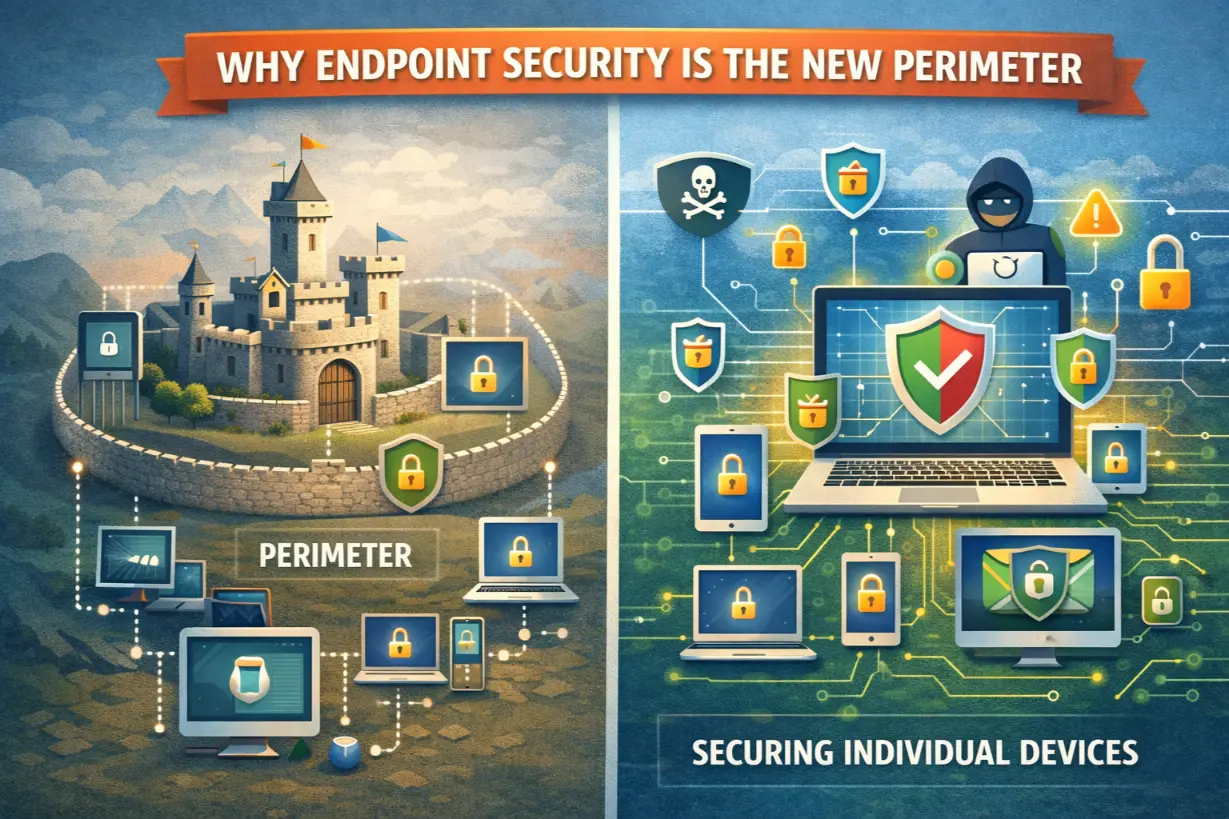
The Perimeter Has Disappeared
There was a time when security was simple.
Employees worked in offices. Devices stayed on the network. Firewalls protected the perimeter. Everything inside was trusted.
That world no longer exists.
Today:
- Employees work from anywhere
- Devices roam freely
- Cloud apps replace internal servers
- Attackers bypass networks entirely
In this environment, endpoint security has become the new perimeter.
This article explains why traditional security models fail, why endpoints are now the primary attack surface, and how managed IT services protect businesses device by device.
What Is an Endpoint?
An endpoint is any device that connects to business systems, including:
- Laptops
- Desktops
- Mobile devices
- Tablets
- Servers
- IoT devices
Each endpoint is a potential entry point for attackers.
Why the Traditional Network Perimeter Failed
Firewalls assume:
- Devices stay inside the network
- Traffic flows through controlled gateways
Modern reality breaks both assumptions.
Attackers now:
- Steal credentials
- Compromise devices remotely
- Use cloud access
- Avoid network defenses entirely
Endpoints are where attacks start.
The Rise of the Remote Workforce
Remote and hybrid work changed everything.
Endpoints now:
- Connect from home networks
- Use public Wi-Fi
- Access cloud apps directly
Security must follow the device — not the network.
Why Endpoints Are Prime Targets
Attackers target endpoints because:
- Users interact with them
- Malware executes on them
- Credentials are stored on them
- Security controls vary widely
A single compromised endpoint can bypass multiple defenses.
Common Endpoint-Based Attacks
Phishing & Malware Execution
Malicious files execute locally — not on servers.
Credential Theft
Keyloggers and memory scraping target endpoints.
Ransomware Deployment
Encryption begins on endpoints and spreads outward.
Unauthorized Access
Lost or stolen devices expose data instantly.
What Endpoint Security Really Means Today
Modern endpoint security goes far beyond antivirus.
It includes:
- Behavior-based threat detection
- Continuous monitoring
- Device health enforcement
- Remote isolation
- Automated response
Endpoints must be actively defended.
Endpoint Detection & Response (EDR)
EDR is the backbone of modern endpoint security.
It provides:
- Real-time behavioral analysis
- Threat hunting
- Automated containment
- Forensic visibility
MSPs rely heavily on EDR to stop attacks early.
How Managed IT Secures Endpoints Effectively
1. Standardized Device Configurations
MSPs enforce:
- Encryption
- Secure baselines
- Patch compliance
Consistency reduces risk.
2. Continuous Monitoring
Endpoints are monitored 24/7 for:
- Suspicious activity
- Performance issues
- Security events
Threats don’t wait for business hours.
3. Least Privilege Access
Users only get what they need.
Admin access is restricted and monitored.
4. Remote Lock & Wipe Capabilities
Lost devices are:
- Locked
- Disabled
- Wiped remotely
Data stays protected.
5. Endpoint Compliance Enforcement
Non-compliant devices:
- Lose access
- Trigger alerts
- Are remediated automatically
Security is enforced, not suggested.
Endpoint Security and Zero Trust
Zero Trust assumes:
“Never trust, always verify.”
Endpoints must:
- Prove identity
- Meet compliance standards
- Be continuously evaluated
Managed IT operationalizes Zero Trust at the device level.
Why Endpoint Security Is a Business Risk Issue
Endpoint breaches lead to:
- Data loss
- Downtime
- Regulatory exposure
- Reputation damage
Security failures aren’t technical problems — they’re business failures.
Common Endpoint Security Mistakes
- Relying on basic antivirus
- No device monitoring
- Ignoring personal devices
- No encryption enforcement
- Inconsistent patching
These gaps are routinely exploited.
Endpoint Security Supports Cyber Insurance & Compliance
Insurers and regulators increasingly require:
- Endpoint protection
- Monitoring
- Access controls
Managed IT helps meet these standards.
Signs Your Endpoint Security Is Weak
- No EDR solution
- No device inventory
- Lost devices unmanaged
- No remote wipe
- Users with admin rights
These are high-risk indicators.
Every Device Is the Front Line
In modern IT, there is no “inside” network anymore.
Every laptop, phone, and workstation is a security perimeter of its own.
Businesses that protect endpoints aggressively survive modern threats. Those that don’t eventually learn the hard way.
Managed IT services ensure endpoint security isn’t reactive — it’s continuous, enforced, and effective.
Unsure how secure your devices really are?
An endpoint security assessment can reveal vulnerabilities before attackers do