Downtime Is More Expensive Than You Think
When systems go down, most businesses calculate downtime like this:
“Employees couldn’t work for two hours.”
But that calculation barely scratches the surface.
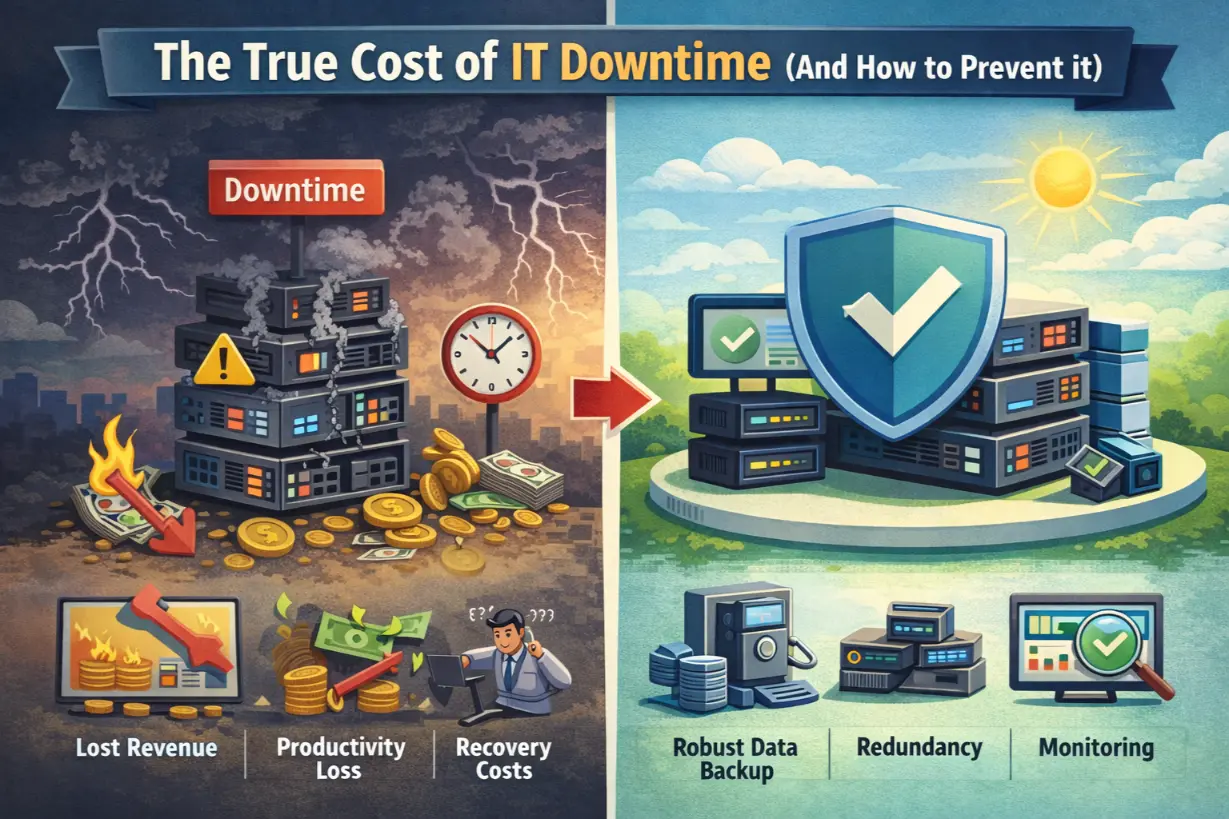
The true cost of IT downtime includes:
- Lost revenue
- Missed opportunities
- Customer dissatisfaction
- Compliance exposure
- Brand damage
- Employee frustration
Downtime isn’t just an IT issue — it’s a financial and strategic threat.
This article breaks down the real cost of IT downtime, why it’s consistently underestimated, and how managed IT services reduce downtime before it impacts the business.
What Counts as IT Downtime?
Downtime isn’t just total outages.
It includes:
- Slow systems
- Intermittent failures
- Application crashes
- Network degradation
- Email outages
“Partial downtime” is still downtime.
The Direct Costs of IT Downtime
Lost Productivity
Employees who can’t access systems:
- Stop working
- Switch tasks inefficiently
- Wait for resolution
Multiply this by hourly wages — then by frequency.
Lost Revenue
Downtime impacts:
- Sales transactions
- Customer service
- Billing and invoicing
- E-commerce
Revenue doesn’t pause — it disappears.
The Hidden Costs of IT Downtime
Customer Trust & Satisfaction
Customers expect availability.
Downtime leads to:
- Missed deadlines
- Service interruptions
- Frustration
Trust is harder to rebuild than systems.
Brand Reputation
Repeated outages:
- Damage credibility
- Encourage churn
- Impact reviews and referrals
Reputation loss compounds over time.
Compliance & Legal Risk
Downtime can trigger:
- Missed regulatory deadlines
- SLA violations
- Contract breaches
The cost extends beyond IT.
Employee Morale & Retention
Frequent issues cause:
- Frustration
- Burnout
- Reduced engagement
Talented employees expect functional tools.
Why Businesses Underestimate Downtime Costs
Downtime Is Viewed as “Rare”
Small outages are normalized.
But frequency matters more than duration.
Costs Are Distributed
Downtime costs appear across:
- Payroll
- Sales
- Customer service
- Operations
No single line item shows the full impact.
“We’ll Fix It When It Breaks” Thinking
Reactive IT accepts downtime as inevitable.
Managed IT treats downtime as preventable.
Common Causes of IT Downtime
Hardware Failure
Aging equipment fails without warning.
Software & Application Issues
Unpatched or misconfigured systems crash.
Network Problems
Bandwidth saturation and device failures cripple access.
Cybersecurity Incidents
Ransomware and breaches cause immediate downtime.
Human Error
Accidental deletions and misconfigurations are common.
Downtime in the Age of Cloud & SaaS
Cloud doesn’t eliminate downtime — it changes it.
Risks include:
- Provider outages
- Internet dependency
- Identity failures
Cloud environments still require management.
How Managed IT Prevents Downtime
Managed IT focuses on prevention, not reaction.
Proactive Monitoring
Issues are detected:
- Before failure
- Before users notice
Early warnings prevent outages.
Preventative Maintenance
Managed IT ensures:
- Hardware health
- Patch compliance
- Capacity planning
Systems fail less often.
Redundancy & Resilience
MSPs design:
- Failover systems
- Redundant connectivity
- High availability architectures
Single points of failure are removed.
Faster Incident Response
When issues occur:
- Response is immediate
- Escalation is defined
- Resolution is faster
Downtime is minimized.
Downtime and Business Continuity
Downtime prevention and recovery go together.
Managed IT ensures:
- Backups are tested
- Recovery plans are validated
- Failover works
Recovery time shrinks dramatically.
Measuring Downtime Properly
Businesses should track:
- Frequency
- Duration
- Impact
- Root causes
Data enables improvement.
Calculating the True Cost of Downtime
Consider:
- Number of affected employees
- Hourly labor cost
- Revenue per hour
- Customer impact
- Recovery effort
The total is usually shocking.
Downtime as a Competitive Disadvantage
While your systems are down:
- Competitors keep operating
- Customers move on
- Opportunities are lost
Uptime is a differentiator.
Signs Downtime Is Costing You More Than You Realize
- Frequent “minor” outages
- Employees complain about slowness
- Customers experience delays
- IT firefighting is constant
These signal unmanaged downtime risk.
Downtime Prevention Is an Investment
Managed IT shifts spending from:
- Emergency fixes
- Downtime losses
To:
- Predictable prevention
- Stability
Prevention is cheaper than recovery.
Leadership’s Role in Reducing Downtime
Executives must:
- Prioritize reliability
- Fund prevention
- Support proactive maintenance
Downtime reflects leadership decisions.
Downtime Is Optional — If You Plan Correctly
Downtime isn’t always avoidable — but most downtime is preventable.
Businesses that accept downtime as “normal” quietly bleed revenue, trust, and productivity.
Managed IT services eliminate preventable downtime through:
- Visibility
- Proactive care
- Resilience design
When IT works consistently, businesses move faster, serve better, and grow stronger.
Not sure how much downtime is really costing your business?
A downtime risk and cost assessment can reveal hidden losses and prevention opportunities.