Hackers Don’t Break In — They Log In
Despite advances in firewalls, endpoint protection, and AI-driven security, one uncomfortable truth remains:
Most cyberattacks succeed because a human was tricked — not because a system was hacked.
Employees click malicious links. They enter credentials into fake portals. They approve fraudulent requests. They reuse passwords.
This doesn’t mean employees are careless — it means attackers design attacks specifically for humans.
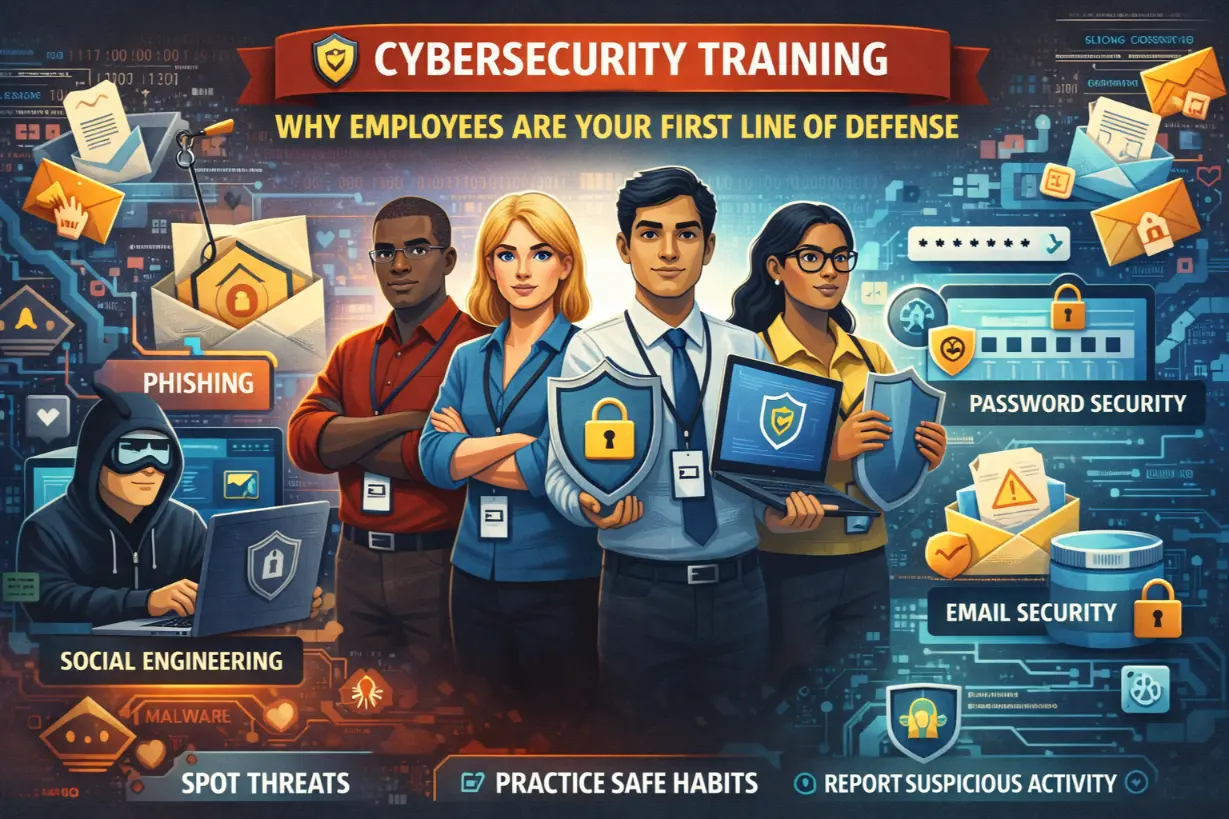
This article explains why employees are your first line of defense, how cybersecurity training reduces risk dramatically, and how managed IT services turn training into a measurable security control — not a checkbox exercise.
Why Humans Are Targeted First
Attackers prefer people because:
- Humans are easier to manipulate than systems
- One mistake bypasses layers of security
- Trust can be exploited quickly
Cybercrime is increasingly psychological, not technical.
The Most Common Employee-Targeted Attacks
Phishing Emails
Fake messages designed to:
- Steal credentials
- Deliver malware
- Trigger financial fraud
Phishing remains the #1 entry point.
Business Email Compromise (BEC)
Employees receive messages that appear to be from:
- Executives
- Vendors
- Finance teams
These attacks exploit authority and urgency.
MFA Fatigue Attacks
Attackers bombard users with:
- Repeated MFA prompts
- Requests that seem legitimate
Eventually, someone clicks “Approve.”
Social Engineering Beyond Email
Attackers now use:
- SMS (smishing)
- Phone calls (vishing)
- Collaboration tools
Training must extend beyond email.
Why Technology Alone Isn’t Enough
Security tools can:
- Block known threats
- Detect suspicious behavior
But they can’t:
- Teach judgment
- Recognize context
- Stop every social trick
Humans remain the final decision point.
The Cost of an Untrained Workforce
Organizations without training experience:
- Higher phishing success rates
- More credential compromise
- Greater financial loss
- Increased ransomware risk
Training directly reduces incident frequency.
What Effective Cybersecurity Training Looks Like
Good training is:
- Ongoing
- Relevant
- Measurable
- Reinforced
Not:
- Annual videos
- One-time checklists
- Fear-based lectures
Core Elements of Strong Security Awareness Training
1. Phishing Simulation Training
Simulated phishing:
- Tests real-world behavior
- Identifies risk patterns
- Reinforces learning
Employees learn by experience.
2. Role-Based Training
Different roles face different risks.
Executives, finance teams, and admins require:
- Advanced training
- BEC awareness
- Targeted simulations
One size does not fit all.
3. Just-In-Time Education
Training tied to:
- Real incidents
- Recent attacks
- Emerging threats
Relevance increases retention.
4. Positive Reinforcement
Effective programs:
- Reward reporting
- Encourage questions
- Avoid blame
Security improves when fear is removed.
The “Human Firewall” Concept
A trained workforce:
- Spots suspicious messages
- Reports threats quickly
- Limits attack spread
Employees become an extension of security controls.
Why Reporting Matters More Than Perfection
No one catches everything.
What matters is:
- Fast reporting
- Early containment
- Reduced impact
Training emphasizes reporting — not punishment.
How Managed IT Delivers Effective Security Training
Managed IT providers operationalize training.
Training Platform Management
MSPs deploy:
- Interactive training platforms
- Automated campaigns
- Progress tracking
Training becomes continuous.
Phishing Simulation Programs
MSPs run:
- Regular simulations
- Targeted scenarios
- Adaptive difficulty
Risk decreases over time.
Metrics & Reporting
Leadership receives:
- Click rates
- Reporting rates
- Risk trends
Training effectiveness is visible.
Integration With Security Response
Reported threats trigger:
- Email removal
- Account checks
- Broader investigation
Training feeds detection.
Cybersecurity Training and Compliance
Many frameworks require:
- Security awareness training
- Proof of completion
- Ongoing education
Managed IT ensures audit readiness.
Cyber Insurance and Employee Training
Insurers increasingly require:
- Documented training programs
- Phishing simulations
- MFA education
Training reduces premiums and claim risk.
Common Myths About Security Training
❌ “Our employees are smart enough”
❌ “Training wastes time”
❌ “We did training last year”
Attackers rely on these assumptions.
Signs Your Organization Needs Better Training
- Frequent phishing incidents
- Low reporting rates
- Credential compromises
- MFA fatigue approvals
These are human-risk indicators.
Training Reduces Burnout, Not Just Risk
Clear guidance:
- Reduces anxiety
- Empowers employees
- Builds confidence
Employees want to do the right thing.
Building a Security-Aware Culture
Culture is built when:
- Leadership supports training
- Reporting is praised
- Security is discussed openly
Security becomes shared responsibility.
The ROI of Cybersecurity Training
Training delivers:
- Fewer incidents
- Faster detection
- Lower recovery costs
- Stronger compliance posture
Few security investments deliver higher ROI.
Leadership’s Role in Employee Security Readiness
Leaders must:
- Participate in training
- Set expectations
- Support accountability
Culture starts at the top.
Your People Are Either a Target — or a Shield
Attackers will always target humans.
The choice is whether employees are:
- The weakest link
- Or the strongest defense
With the right training, employees become alert, confident, and responsive — dramatically reducing risk.
Managed IT services transform cybersecurity training from a checkbox into a living security control that evolves alongside threats.
Your first line of defense isn’t a firewall.
It’s your people.
Do you know how your employees would respond to a real phishing attack today?
A cybersecurity training and phishing simulation assessment can reveal human risk before attackers exploit it.