The Cloud Didn’t Make IT Cheaper — It Made Overspending Easier
The cloud promised:
- Lower upfront costs
- Elastic scaling
- Pay-for-what-you-use pricing
And it delivered — technically.
But for many organizations, cloud costs now:
- Grow unpredictably
- Exceed on-prem budgets
- Lack transparency
The problem isn’t the cloud itself — it’s how it’s managed.
This article explains why cloud cost overruns happen, how cloud cost optimization works, and how managed IT services help organizations stop overpaying while still benefiting from cloud flexibility.
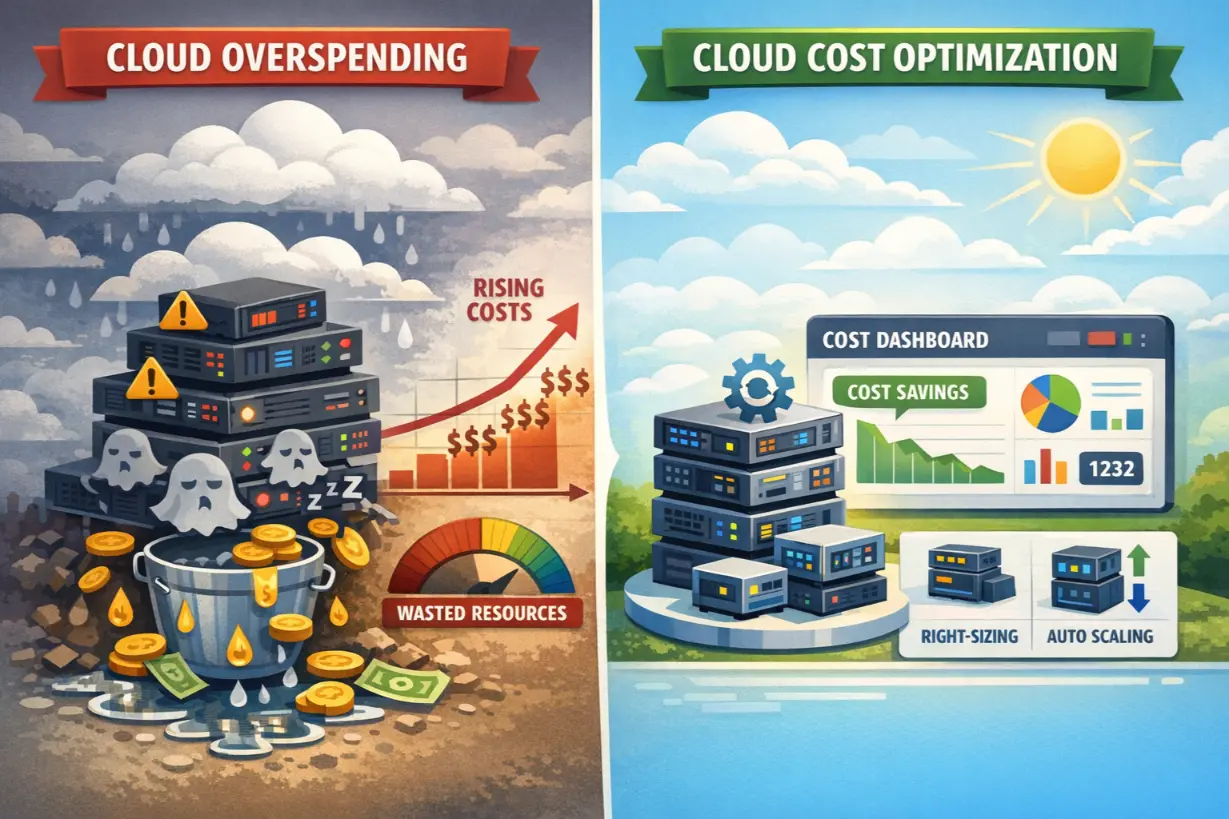
Why Cloud Costs Spiral Out of Control
Cloud environments make it easy to deploy — and easy to forget.
Common drivers of overspending include:
- Overprovisioned resources
- Idle workloads
- Shadow IT
- Lack of ownership
- No cost visibility
Without governance, cloud spending drifts upward quietly.
The Biggest Cloud Cost Wasters
Overprovisioned Compute & Storage
Resources are often sized for peak demand:
- Large virtual machines
- Excess storage
- Always-on environments
Most workloads never use full capacity.
Idle & Orphaned Resources
Common examples:
- Unused VMs
- Old snapshots
- Detached storage
- Test environments left running
These costs add up monthly.
No Lifecycle Management
Cloud resources created for:
- Projects
- Testing
- Temporary needs
Often remain indefinitely.
Licensing & Subscription Waste
Cloud licensing issues include:
- Duplicate licenses
- Underused subscriptions
- Paying for premium tiers unnecessarily
Why “Lift and Shift” Causes Cost Shock
Many organizations move to the cloud by:
- Migrating existing workloads unchanged
This often results in:
- Inefficient architectures
- Higher operating costs
- Poor performance-to-cost ratios
Optimization must follow migration.
What Cloud Cost Optimization Really Means
Cloud cost optimization is not:
- Cutting blindly
- Reducing performance
- Limiting innovation
It is:
- Aligning spend with value
- Eliminating waste
- Right-sizing resources
- Improving efficiency
Optimization supports the business — not constrains it.
The FinOps Approach to Cloud Spending
FinOps (Cloud Financial Operations) bridges:
- IT
- Finance
- Leadership
It focuses on:
- Cost visibility
- Accountability
- Continuous optimization
Managed IT often serves as the FinOps engine.
Core Pillars of Cloud Cost Optimization
1. Visibility & Reporting
You can’t optimize what you can’t see.
Optimization starts with:
- Cost dashboards
- Usage reports
- Departmental allocation
Transparency changes behavior.
2. Ownership & Accountability
Every resource should have:
- An owner
- A purpose
- A lifecycle
Unowned resources are almost always wasteful.
3. Right-Sizing & Performance Tuning
Managed IT analyzes:
- CPU and memory usage
- Storage performance
- Network throughput
Resources are sized to actual demand.
4. Automation & Scheduling
Automation reduces cost by:
- Powering down non-production systems
- Enforcing expiration policies
- Scaling dynamically
Idle resources stop costing money.
5. Architecture Optimization
Better architectures reduce cost.
Examples include:
- Serverless workloads
- Auto-scaling
- Managed services
Design affects long-term spend.
How Managed IT Optimizes Cloud Costs
Managed IT providers treat cloud cost as an operational discipline.
Continuous Cost Monitoring
MSPs track:
- Trends
- Anomalies
- Unexpected spikes
Issues are addressed early.
Policy-Based Governance
MSPs enforce:
- Resource standards
- Budget alerts
- Approval workflows
Guardrails prevent sprawl.
Cost-Aware Design Decisions
Before deploying resources, MSPs consider:
- Cost impact
- Long-term usage
- Alternatives
Decisions are intentional.
Regular Optimization Reviews
Optimization is not one-time.
MSPs conduct:
- Monthly or quarterly reviews
- Usage analysis
- Adjustment planning
Savings compound over time.
Cloud Cost Optimization and Performance
Cheaper doesn’t mean slower.
Optimized environments often:
- Perform better
- Scale more efficiently
- Reduce outages
Waste often causes performance issues.
Cloud Cost Optimization for SMBs vs Enterprises
SMBs:
- Need simplicity
- Lack cloud finance expertise
Managed IT delivers enterprise-level optimization without complexity.
Cloud Optimization and Compliance
Unused or unmanaged resources:
- Increase attack surface
- Violate compliance principles
Optimization improves security posture.
Common Cloud Cost Optimization Mistakes
- Cutting resources without analysis
- Ignoring performance impact
- No stakeholder alignment
- One-time cleanup mentality
Optimization must be continuous.
Signs You’re Overpaying for the Cloud
- Cloud bills keep growing
- No clear cost attribution
- No optimization cadence
- Surprise monthly charges
These indicate unmanaged spend.
Cloud Cost Optimization as a CFO Priority
Cloud spending is operational — not capital.
CFOs need:
- Predictability
- Accountability
- Control
Managed IT provides financial clarity.
Aligning Cloud Spend With Business Value
Every dollar spent should:
- Support operations
- Enable growth
- Reduce risk
Optimization ensures spend maps to outcomes.
The Long-Term Value of Cloud Optimization
Effective optimization delivers:
- Lower total cost of ownership
- Better performance
- Improved governance
- Stronger security
Cloud becomes strategic — not expensive.
The Cloud Rewards Discipline
The cloud doesn’t punish usage — it punishes lack of management.
Organizations that treat cloud cost optimization as an ongoing discipline:
- Spend less
- Perform better
- Scale faster
Managed IT services ensure cloud environments stay efficient, secure, and aligned with business goals — turning the cloud back into the advantage it was meant to be.
Not sure how much cloud waste is hidden in your environment?
A cloud cost optimization assessment can uncover immediate savings and long-term efficiencies.