When the Network Slows Down, Everything Suffers
Most businesses don’t notice their network — until it stops working.
Email lags. Applications crawl. Video calls freeze. File transfers fail. Productivity plummets.
The network is the invisible backbone of every digital operation. When performance degrades, the impact ripples across the entire organization.
This article explores how network monitoring acts as the silent protector of business performance, and why managed IT services rely on it to prevent disruptions before they’re felt.
Why Network Performance Matters More Than Ever
Modern businesses rely on networks for:
- Cloud applications
- Remote work
- VoIP communications
- Data access
- Security enforcement
A slow network isn’t an inconvenience — it’s an operational failure.
What Is Network Monitoring?
Network monitoring continuously tracks:
- Traffic flow
- Device health
- Bandwidth usage
- Latency
- Packet loss
It provides real-time visibility into network behavior.
Why Businesses Struggle Without Network Monitoring
Without monitoring:
- Problems are discovered by users
- Root causes are unclear
- Fixes are reactive
- Downtime lasts longer
Blind spots are expensive.
Common Network Performance Killers
Bandwidth Saturation
Cloud apps, video conferencing, and backups compete for bandwidth.
Monitoring reveals:
- Usage patterns
- Bottlenecks
- Congestion points
Failing Hardware
Switches, routers, and firewalls degrade over time.
Monitoring detects:
- Error rates
- Temperature spikes
- Memory issues
Misconfigurations
Small configuration errors cause:
- Routing loops
- Slow paths
- Security gaps
Monitoring identifies anomalies quickly.
Latency & Packet Loss
These invisible issues:
- Break VoIP
- Kill remote access
- Slow cloud apps
Monitoring makes them visible.
How Managed IT Uses Network Monitoring Proactively
1. Real-Time Alerts
MSPs receive alerts before users complain.
Issues are resolved quietly.
2. Performance Baselines
Monitoring establishes “normal” behavior.
Deviations signal problems.
3. Capacity Planning
Usage trends guide:
- Upgrades
- Expansion
- Optimization
Growth is planned — not reactive.
4. Security Visibility
Unusual traffic patterns may indicate:
- Malware
- Data exfiltration
- Intrusions
Monitoring supports security.
Network Monitoring vs Network Management
Monitoring detects issues.
Management:
- Fixes them
- Optimizes performance
- Improves reliability
Managed IT does both.
The Business Impact of Proactive Network Monitoring
- Fewer outages
- Faster issue resolution
- Higher productivity
- Better user experience
Stability becomes normal.
Why Network Issues Are Often Misdiagnosed
Without monitoring, problems are blamed on:
- Internet providers
- Applications
- User devices
Monitoring reveals the truth.
Network Monitoring in Cloud & Hybrid Environments
Modern networks span:
- On-prem systems
- Cloud platforms
- Remote users
Monitoring must be holistic.
Common Network Monitoring Mistakes
- Relying on ISP tools
- Monitoring only uptime
- Ignoring performance metrics
- No alert escalation
Partial visibility is false security.
Signs Your Business Needs Better Network Monitoring
- Frequent “slow network” complaints
- Unexplained outages
- VoIP quality issues
- Cloud app performance problems
These are warnings.
Network Monitoring as Competitive Advantage
Reliable networks:
- Enable growth
- Support innovation
- Improve customer satisfaction
Downtime erodes trust.
The Best Network Monitoring Is Invisible
When done right, network monitoring is unnoticed.
Users stay productive. Systems stay fast. Issues disappear before they escalate.
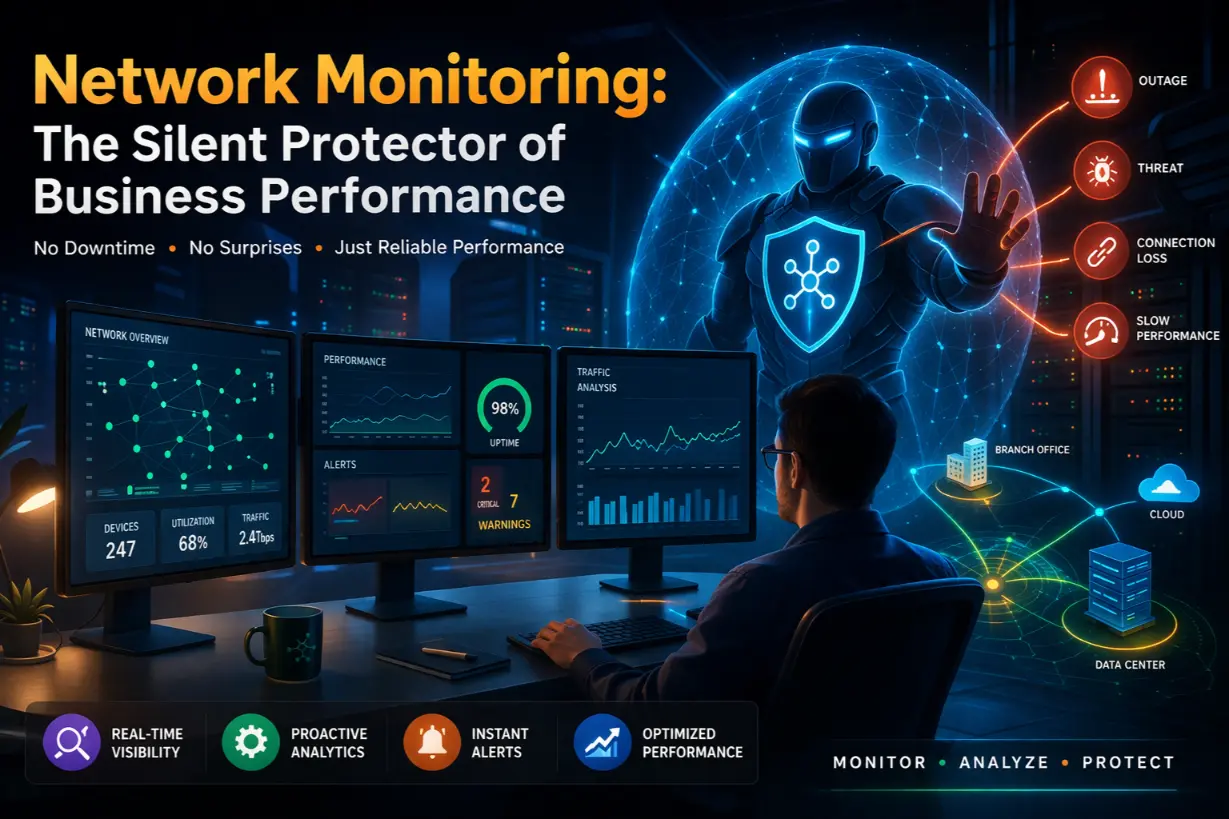
That’s why network monitoring is the silent protector of business performance — and a cornerstone of managed IT services.
Not sure how healthy your network really is?
A network performance assessment can uncover hidden issues before they disrupt operations.