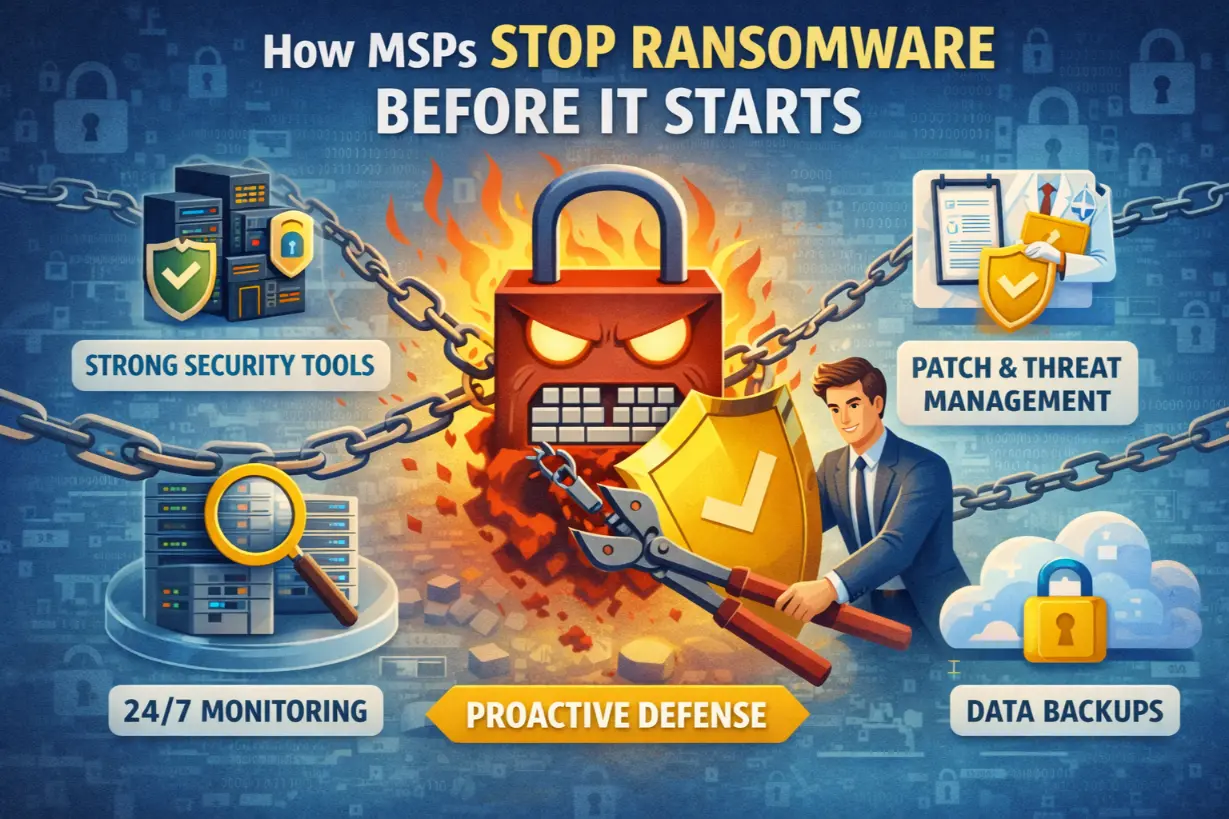
Ransomware Doesn’t Knock — It Explodes
Ransomware doesn’t announce itself politely.
It:
- Enters quietly
- Spreads rapidly
- Encrypts aggressively
- Demands payment mercilessly
For many businesses, ransomware is the single most disruptive cyber threat they will ever face.
What makes it worse?
Most ransomware attacks are preventable — but only when security is proactive, layered, and continuously monitored.
This article explains how Managed Service Providers (MSPs) stop ransomware before it starts, and why reactive defenses fail every time.
How Ransomware Actually Gets In
Understanding prevention starts with understanding entry points.
1. Phishing Emails
The #1 delivery method.
Ransomware arrives disguised as:
- Invoices
- Shipping notices
- DocuSign requests
- Password resets
One click is all it takes.
2. Compromised Credentials
Stolen usernames and passwords allow attackers to:
- Log in remotely
- Deploy ransomware manually
- Disable defenses
Credential theft turns ransomware into an insider threat.
3. Unpatched Vulnerabilities
Outdated systems expose:
- Known exploits
- Automated attack scripts
Attackers scan constantly for weaknesses.
4. Remote Access Tools
Poorly secured:
- RDP
- VPNs
- Remote management tools
These are prime ransomware entry points.
Why Traditional Security Fails Against Ransomware
Traditional security tools are:
- Signature-based
- Reactive
- Isolated
They often detect ransomware after encryption begins.
At that point, the damage is already done.
The MSP Approach: Stop Ransomware Before Execution
MSPs don’t rely on a single tool.
They deploy layered, proactive defenses designed to stop ransomware at every stage.
1. Email Security & Phishing Prevention
Since most ransomware starts with email, MSPs focus here first.
They implement:
- Advanced spam filtering
- Attachment sandboxing
- URL rewriting and blocking
- Impersonation protection
Suspicious emails never reach users.
2. Endpoint Detection & Response (EDR)
Modern MSPs use behavior-based security, not just antivirus.
EDR tools:
- Monitor process behavior
- Detect encryption attempts
- Kill malicious processes instantly
- Isolate infected devices
Ransomware is stopped mid-attack.
3. Least Privilege & Access Control
MSPs lock down permissions.
They enforce:
- Role-based access
- Admin privilege restrictions
- MFA everywhere
Even if malware runs, it can’t spread.
4. Patch & Vulnerability Management
Ransomware thrives on outdated systems.
MSPs ensure:
- OS patches are current
- Firmware is updated
- Vulnerabilities are closed quickly
Attack surfaces shrink dramatically.
5. Network Segmentation
Flat networks allow ransomware to spread unchecked.
MSPs design:
- Segmented networks
- Restricted lateral movement
- Controlled access zones
One infected device doesn’t take down the business.
6. 24/7 Monitoring & Threat Hunting
Ransomware doesn’t wait for business hours.
MSPs provide:
- Continuous monitoring
- Alert triage
- Threat investigation
- Rapid response
Attacks are stopped in minutes — not hours.
7. Secure Backup & Recovery (The Last Line of Defense)
Even the best defenses plan for failure.
MSPs implement:
- Immutable backups
- Offsite replication
- Frequent testing
- Rapid recovery processes
If ransomware hits, data is restored — not ransomed.
Why Ransomware Is a Business Problem, Not Just IT
Ransomware impacts:
- Revenue
- Operations
- Legal standing
- Brand reputation
Leadership must treat ransomware prevention as enterprise risk management.
Common Ransomware Prevention Mistakes
- Relying on antivirus alone
- Ignoring MFA
- Skipping patching
- No backup testing
- Assuming insurance will cover everything
These assumptions fail in real attacks.
How MSPs Reduce Ransomware Insurance Risk
Insurers now require:
- MFA
- Endpoint protection
- Backups
- Monitoring
MSP-managed environments are more insurable and often qualify for lower premiums.
Ransomware Prevention Is an Ongoing Process
Attackers evolve constantly.
MSPs:
- Update defenses
- Adjust policies
- Monitor new threats
- Train users
Security is continuous — not a one-time setup.
The Difference Between “Protected” and “Prepared”
Being protected means having tools.
Being prepared means:
- Knowing how attacks happen
- Detecting them early
- Responding instantly
- Recovering quickly
MSPs deliver preparation — not just protection.
Ransomware Can Be Stopped
Ransomware is brutal — but it’s not unbeatable.
Businesses that rely on:
- Reactive IT
- Minimal security
- Hope-based defenses
Will eventually pay the price.
Those that partner with MSPs gain:
- Visibility
- Control
- Resilience
And when ransomware strikes — it stops cold.
Concerned about ransomware risk?
A ransomware readiness assessment can identify weaknesses before attackers do.