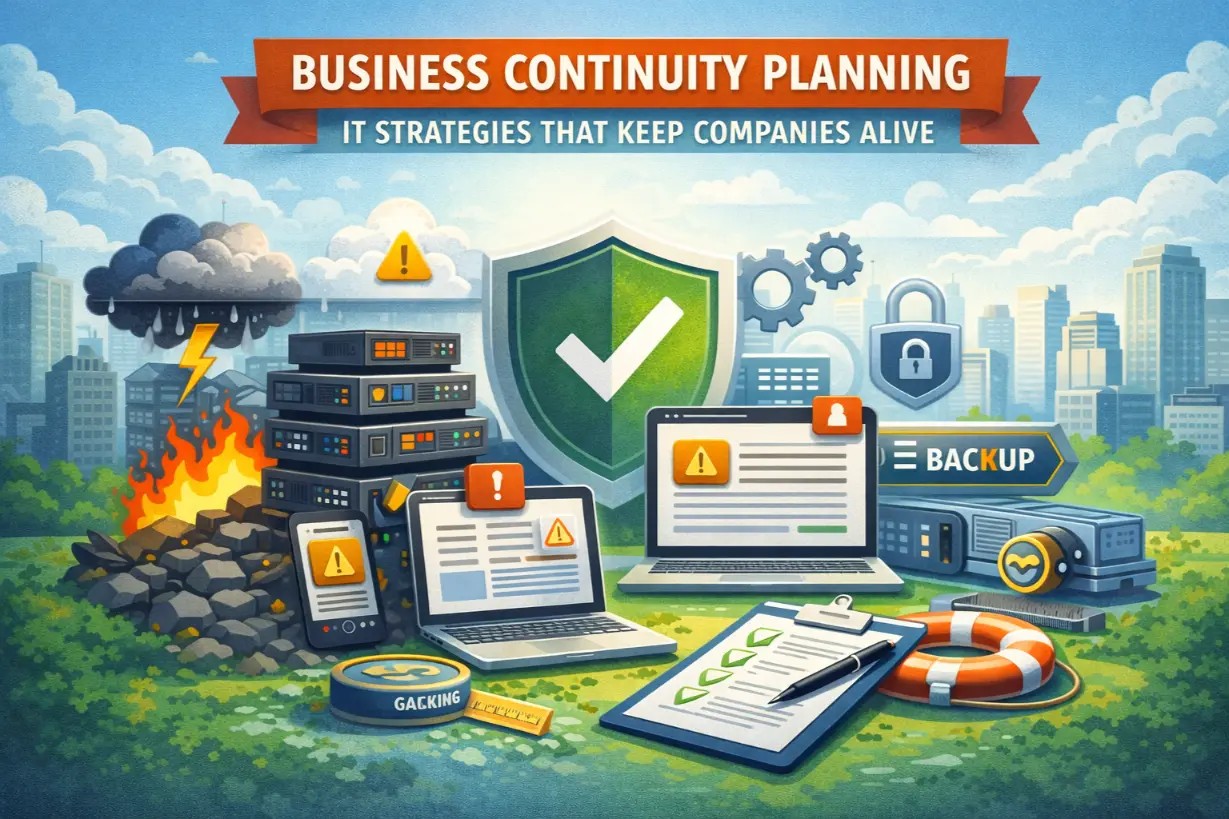
Businesses Don’t Fail From Disasters — They Fail From Unpreparedness
Disasters are inevitable.
Power failures. Cyberattacks. Hardware failures. Human error. Natural events. Supply chain disruptions.
What separates businesses that survive from those that disappear isn’t luck — it’s business continuity planning.
Too many organizations believe continuity planning is just backups or insurance. In reality, it’s a coordinated IT strategy designed to keep operations running when everything goes wrong.
Understanding Business Continuity Planning
This article breaks down the IT strategies that keep companies alive, and how managed IT services turn continuity from a document into a living system.
What Is Business Continuity Planning (BCP)?
Business Continuity Planning is the process of ensuring critical business functions continue during and after a disruptive event.
From an IT perspective, BCP focuses on:
- System availability
- Data integrity
- Communication continuity
- Rapid recovery
It’s not about avoiding incidents — it’s about surviving them.
Business Continuity vs Disaster Recovery
These terms are often confused.
Disaster Recovery (DR)
- Focuses on restoring IT systems
- Primarily technical
- Reactive
Business Continuity (BC)
- Focuses on keeping the business operational
- Cross-departmental
- Proactive
Disaster recovery supports business continuity — but BC is broader and more strategic.
Why Business Continuity Is Now a Leadership Issue
Modern businesses depend on technology for:
- Revenue generation
- Customer service
- Supply chains
- Compliance
- Communication
When IT fails, the business stops.
Executives must treat continuity planning as:
- Financial risk management
- Brand protection
- Operational insurance
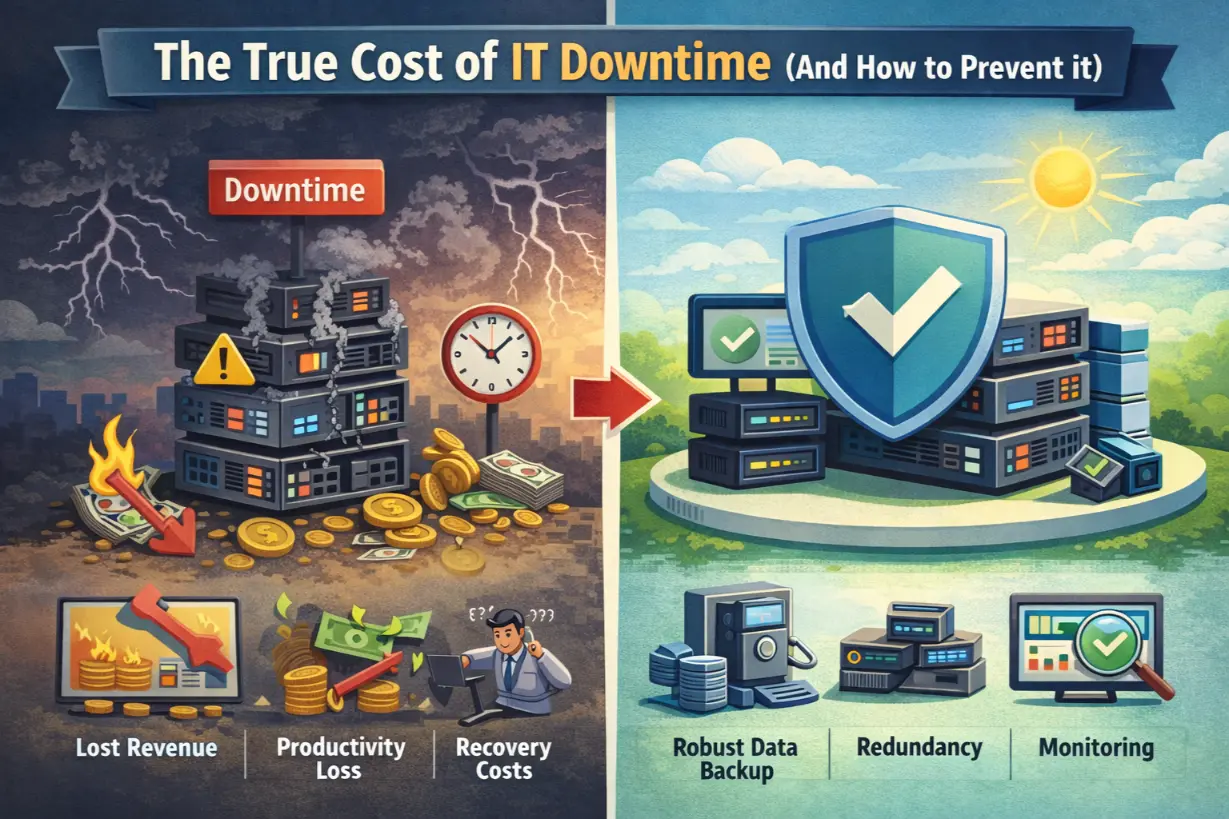
The True Cost of Poor Continuity Planning
Organizations without effective BCP experience:
- Extended downtime
- Permanent data loss
- Customer churn
- Regulatory penalties
- Reputation damage
Many never fully recover.
Core IT Strategies That Enable Business Continuity
1. Risk Assessment & Impact Analysis
Continuity planning starts with understanding risk.
MSPs help identify:
- Critical systems
- Acceptable downtime thresholds
- Data loss tolerance
- Single points of failure
This defines priorities.
2. Redundancy & High Availability
Single systems are single points of failure.
Continuity-focused IT includes:
- Redundant servers
- Failover internet connections
- Cloud-based workloads
- Load balancing
If one system fails, another takes over.
3. Backup & Recovery Architecture
Backups are useless if they don’t restore quickly.
Effective continuity planning defines:
- Recovery Time Objectives (RTO)
- Recovery Point Objectives (RPO)
- Backup frequency
- Storage locations
Backups must be tested — not assumed.
4. Cloud & Hybrid Infrastructure
Cloud platforms offer:
- Geographic redundancy
- Scalability
- Rapid deployment
Hybrid environments blend on-prem control with cloud resilience.
Implementing Business Continuity Planning in Your Organization
5. Security & Threat Containment
Cyber incidents are now a top continuity risk.
BCP must include:
- Threat detection
- Incident response
- Ransomware recovery
- Access controls
Security and continuity are inseparable.
The Role of Managed IT in Business Continuity
Managed IT providers operationalize continuity.
They provide:
- 24/7 monitoring
- Automated failover
- Proactive maintenance
- Incident response
- Documentation & testing
Continuity becomes active — not theoretical.
Common Business Continuity Mistakes
- Assuming backups equal continuity
- Failing to test recovery plans
- Ignoring cloud dependencies
- Underestimating cyber risk
- Treating BCP as an IT-only issue
These gaps surface during crises — not before.
Business Continuity for Remote & Hybrid Work
Remote work introduces new risks:
- Home network failures
- Device loss
- Cloud reliance
- Identity exposure
Managed IT extends continuity beyond the office.
Testing: The Most Overlooked Step
A plan that isn’t tested isn’t a plan.
MSPs conduct:
- Recovery simulations
- Failover testing
- Tabletop exercises
Testing reveals weaknesses safely.
Business Continuity as Competitive Advantage
Prepared businesses:
- Recover faster
- Retain customers
- Maintain trust
- Protect revenue
Resilience becomes a differentiator.
Signs Your Business Continuity Plan Is Weak
- No documented recovery times
- Unclear responsibilities
- Infrequent backup testing
- No cyber incident playbooks
- Reliance on single systems
These are warnings — not inconveniences.
Continuity Is Survival
Disruptions will happen.
The question isn’t if — it’s how prepared you are when they do.
Business continuity planning transforms IT from a vulnerability into a lifeline. With the right strategies and managed IT support, companies don’t just recover — they endure.
Not sure your business could survive a major disruption?
A business continuity assessment can reveal risks before they become crises.
Effective Business Continuity Planning Strategies