Cyber Insurance Is No Longer Easy or Cheap
Just a few years ago, cyber insurance was straightforward.
Low premiums. Minimal questionnaires. Broad coverage.
Today, that landscape has changed dramatically.
Businesses now face:
- Higher premiums
- Lower coverage limits
- More exclusions
- Stricter underwriting
Why? Because cyber incidents are more frequent, more expensive, and more disruptive than ever.
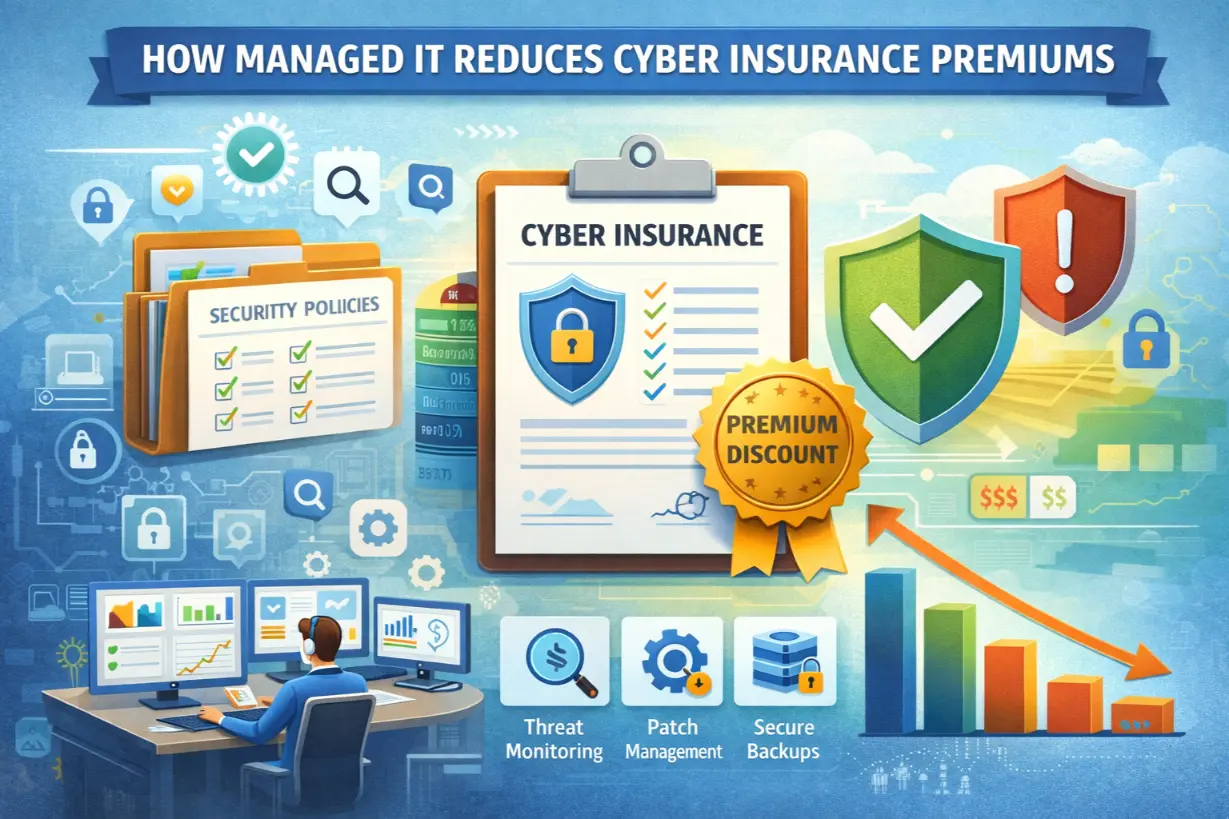
This article explains how managed IT services directly reduce cyber insurance premiums, improve insurability, and protect businesses from uncovered losses.
Why Cyber Insurance Premiums Are Rising
Insurers are paying out massive claims due to:
- Ransomware
- Business email compromise
- Data breaches
- Extended downtime
As losses increase, insurers demand better risk controls.
What Cyber Insurers Really Care About
Insurers don’t just look at revenue or size.
They evaluate:
- Security posture
- Controls enforcement
- Incident history
- Recovery capability
Better controls = lower risk = better pricing.
Core Cybersecurity Controls Insurers Require
Multi-Factor Authentication (MFA)
MFA is now mandatory for:
- Remote access
- Admin accounts
Lack of MFA often leads to denied coverage.
Endpoint Security
Insurers expect:
- EDR solutions
- Centralized monitoring
- Threat response capabilities
Basic antivirus is no longer sufficient.
Backup & Ransomware Recovery
Insurers assess:
- Backup frequency
- Offline or immutable storage
- Recovery testing
No backups = no coverage.
Patch & Vulnerability Management
Unpatched systems increase risk.
Insurers want proof of:
- Regular patching
- Vulnerability remediation
- Monitoring
Security Awareness Training
Human error drives claims.
Insurers expect:
- User training
- Phishing simulations
- Policy enforcement
How Managed IT Aligns With Insurance Requirements
Managed IT providers operationalize insurer expectations.
1. Enforced Security Baselines
MSPs standardize:
- MFA
- Device security
- Access controls
Consistency reduces risk.
2. Continuous Monitoring & Reporting
Insurers want visibility.
Managed IT provides:
- Security logs
- Incident reports
- Control validation
Evidence supports underwriting.
3. Rapid Incident Detection & Response
Faster response means:
- Smaller claims
- Less damage
- Lower payouts
Insurers reward resilience.
4. Documented Processes & Controls
Underwriters love documentation.
MSPs maintain:
- Policies
- Procedures
- Incident response plans
Preparation lowers premiums.
Managed IT Improves Cyber Insurance Outcomes
Businesses with managed IT:
- Qualify for coverage more easily
- Secure better pricing
- Avoid denied claims
- Reduce renewal surprises
Risk maturity matters.
Cyber Insurance Is Not a Substitute for Security
Insurance covers financial loss — not operational chaos.
Managed IT:
- Prevents incidents
- Reduces severity
- Speeds recovery
Insurance is a safety net, not a defense strategy.
Common Cyber Insurance Mistakes Businesses Make
- Overstating security controls
- Assuming coverage is automatic
- Ignoring exclusions
- Failing to update controls
Misrepresentation leads to denied claims.
How MSPs Help During Cyber Insurance Claims
After an incident, MSPs provide:
- Incident documentation
- Forensic data
- Recovery timelines
- Control evidence
This supports successful claims.
Cyber Insurance Questionnaires Explained
Questionnaires assess:
- Technical controls
- Governance
- Recovery readiness
Managed IT ensures answers are accurate — and defensible.
The Future of Cyber Insurance
Expect:
- More requirements
- Higher scrutiny
- Closer ties to IT maturity
Businesses without managed IT will struggle to obtain coverage.
Signs Your Cyber Insurance Costs Are Higher Than Necessary
- Missing MFA
- No EDR
- Weak backup strategy
- No monitoring
- No training
These gaps drive premiums up.
Managed IT as an Insurance Optimization Tool
Managed IT reduces:
- Incident frequency
- Claim size
- Underwriting uncertainty
Lower risk = better pricing.
Security Pays for Itself
Cyber insurance premiums reflect risk.
Managed IT reduces risk.
The result?
- Lower premiums
- Better coverage
- Fewer incidents
In today’s threat landscape, managed IT isn’t just protection — it’s a financial strategy.
Not sure if your IT controls meet cyber insurance requirements?
A cybersecurity readiness assessment can identify gaps before renewal season.