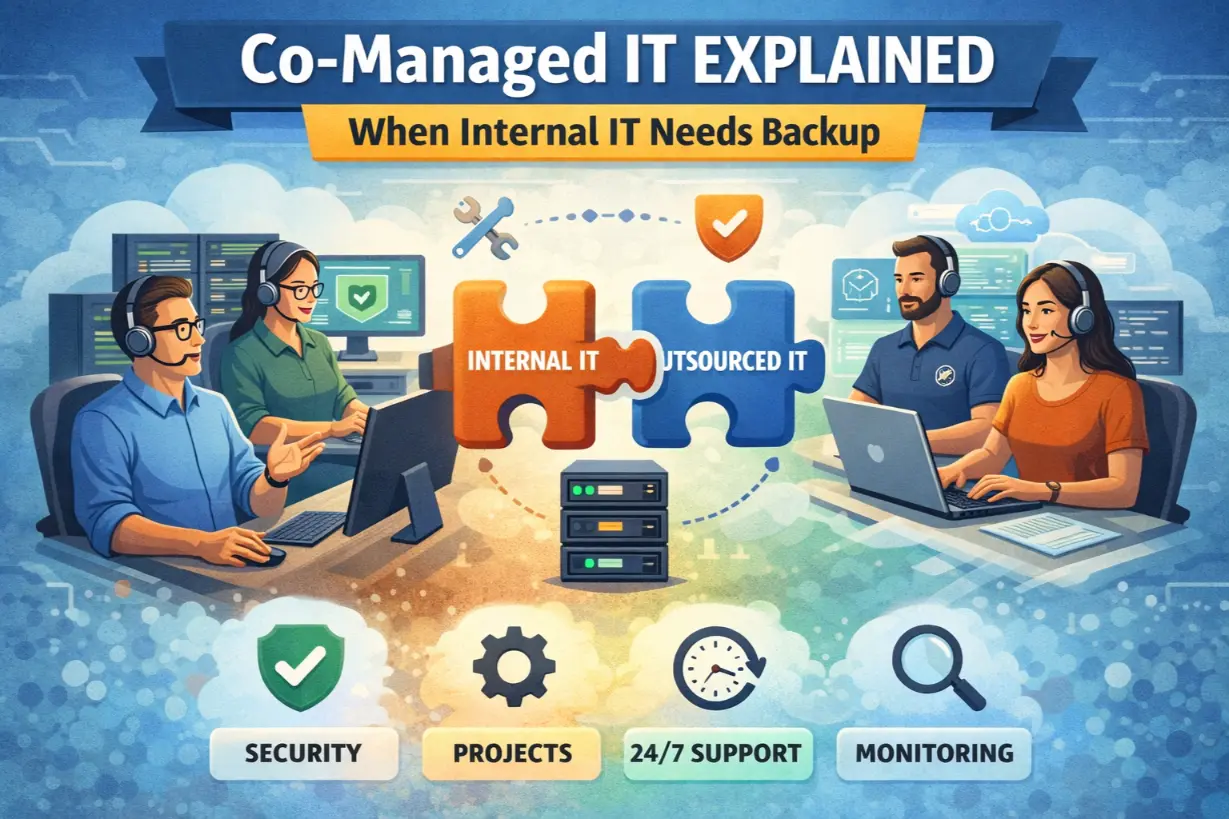
Internal IT Teams Are Under Pressure
Internal IT teams are stretched thinner than ever.
They’re expected to:
- Maintain uptime
- Secure the organization
- Support users
- Implement new technologies
- Manage vendors
- Stay compliant
- Plan for the future
All while fighting fires daily.
At some point, even the best internal IT teams hit a limit. That’s where co-managed IT enters the picture—not as a replacement, but as a force multiplier.
This article explains what co-managed IT really is, when it makes sense, and how businesses use it to strengthen—not sideline—their internal IT teams.

What Is Co-Managed IT?
Co-managed IT is a hybrid IT support model where an internal IT team partners with a Managed Service Provider (MSP) to share responsibility for technology operations.
Instead of outsourcing everything, businesses:
- Retain internal control
- Augment gaps with external expertise
- Scale resources on demand
It’s collaboration, not replacement.
How Co-Managed IT Works
Co-managed IT is flexible by design.
Common responsibility splits include:
Internal IT Handles:
- Day-to-day user support
- Business-specific applications
- Strategic decision-making
- Internal relationships
MSP Handles:
- 24/7 monitoring
- Cybersecurity operations
- Patch and update management
- Backup and disaster recovery
- Advanced troubleshooting
- Infrastructure management
The result is a balanced workload and higher system resilience.
Why Businesses Choose Co-Managed IT
1. Internal IT Burnout Is Real
Overworked IT teams:
- Miss warning signs
- Delay updates
- Make rushed decisions
- Become reactive
Co-managed IT relieves pressure without eliminating internal roles.
2. Specialized Skills Are Hard to Maintain
No internal team can be experts in:
- Cybersecurity
- Cloud infrastructure
- Compliance
- Automation
- Disaster recovery
MSPs provide deep specialization on demand.
3. 24/7 Coverage Is Unrealistic Internally
Most internal IT teams operate business hours.
Co-managed IT delivers:
- After-hours monitoring
- Overnight issue resolution
- Weekend coverage
Problems are fixed before staff returns.
4. Projects Stall Without Extra Hands
Major initiatives often overwhelm internal resources:
- Cloud migrations
- Infrastructure refreshes
- Security upgrades
Co-managed IT accelerates execution without permanent hiring.
Co-Managed IT vs Fully Managed IT
| Aspect | Co-Managed IT | Fully Managed IT |
| Internal IT Team | Required | Optional |
| Control | Shared | Outsourced |
| Flexibility | High | Moderate |
| Scalability | High | High |
| Cost Model | Variable | Flat |
Co-managed IT is ideal when businesses want control without overload.
When Is Co-Managed IT the Right Choice?
Co-managed IT is best suited for:
- Mid-sized organizations
- Companies with 1–5 IT staff
- Rapidly growing businesses
- Regulated industries
- Organizations modernizing infrastructure
If your IT team is always reacting, co-managed IT can restore balance.
Common Co-Managed IT Use Cases
Security Operations
MSPs handle:
- Threat monitoring
- Incident response
- Vulnerability management
Infrastructure Monitoring
- Servers
- Networks
- Cloud workloads
Patch & Update Automation
Ensuring consistency without disruption.
Backup & DR Management
Protection without administrative burden.
Escalation Support
Complex problems resolved faster.
What Co-Managed IT Is NOT
❌ Not a takeover
❌ Not staff replacement
❌ Not micromanagement
❌ Not loss of visibility
The best MSPs work behind the scenes, empowering internal teams.
How Co-Managed IT Improves Business Outcomes
- Reduced downtime
- Stronger security posture
- Faster project completion
- Better staff retention
- Improved IT morale
- More strategic focus
Internal IT shifts from firefighting to innovation.
Key Considerations When Choosing a Co-Managed IT Partner
Look for MSPs that:
- Respect internal expertise
- Offer flexible service models
- Provide transparency
- Document everything
- Align with business goals
A good co-managed relationship feels like an extension of your team.
The Future of IT Is Collaborative
As technology complexity grows, solo IT teams struggle.
Co-managed IT reflects the reality of modern IT:
- Shared responsibility
- Specialized expertise
- Continuous coverage
It’s not about outsourcing — it’s about building resilience.
Strong IT Teams Ask for Backup
The best IT leaders know when to ask for help.
Co-managed IT doesn’t weaken internal teams — it amplifies them.
When internal IT and MSPs work together, businesses gain:
- Stability
- Security
- Scalability
- Strategic clarity
And most importantly — peace of mind.
Is your IT team stretched too thin?
A co-managed IT assessment can identify gaps and opportunities without disrupting internal operations.