Why MSP Pricing Feels So Confusing
Ask three managed service providers for pricing and you’ll often get three completely different answers.
Per user. Per device. Flat rate. Tiered plans. Add-ons. Exclusions. “Out-of-scope” fees.
It’s no wonder business owners struggle to understand what they’re actually paying for.
This article breaks down the most common MSP pricing models, explains what’s typically included (and excluded), and helps you evaluate managed IT costs based on value and risk reduction — not just price.
Why MSP Pricing Isn’t One-Size-Fits-All
Managed IT pricing reflects:
- Business size
- Complexity
- Risk profile
- Service expectations
A law firm, a manufacturer, and a SaaS company all need different support models.
The Most Common MSP Pricing Models Explained
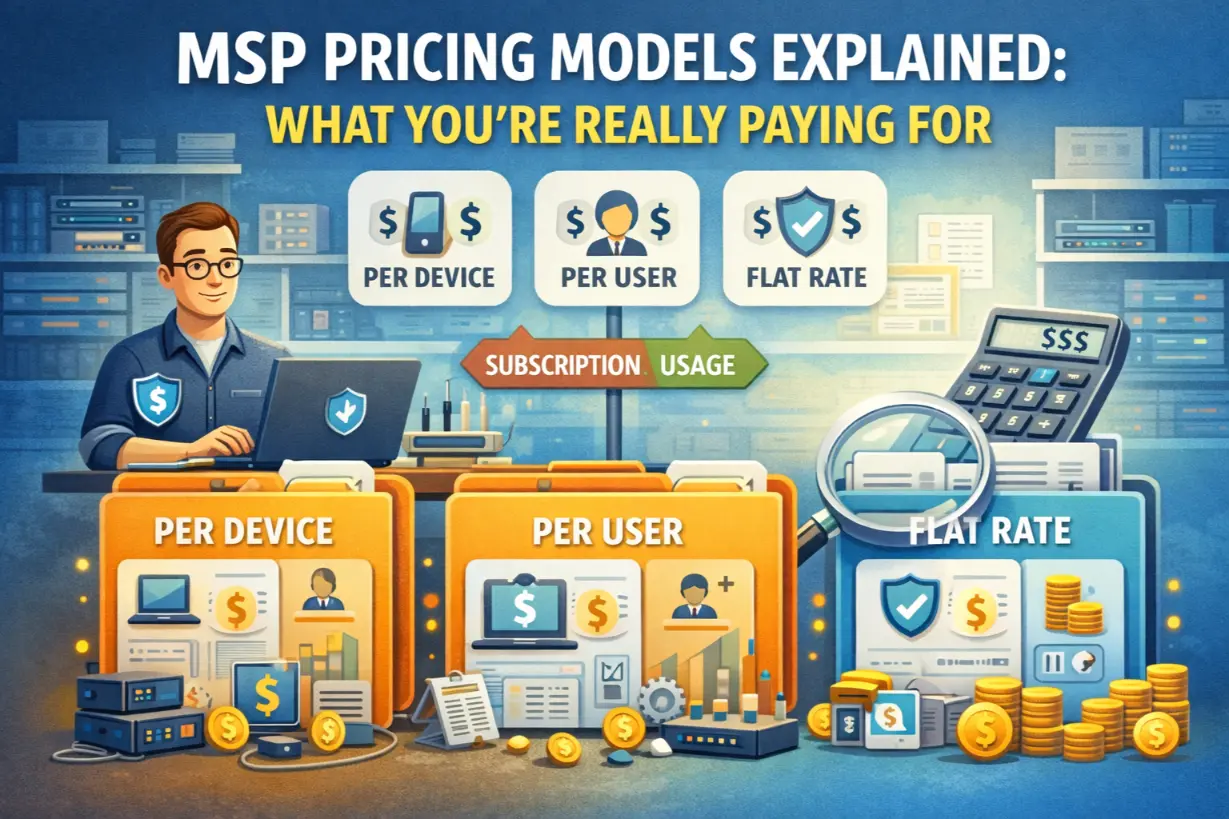
1. Per-User Pricing
How it works:
You pay a fixed monthly fee for each user.
What it includes:
- User support
- Device management
- Access to systems
Pros:
- Predictable scaling
- Easy budgeting
Cons:
- Power users may cost more
- Shared devices can complicate pricing
Best for: Knowledge workers and service-based businesses.
2. Per-Device Pricing
How it works:
You pay per managed device (workstations, servers, firewalls).
What it includes:
- Monitoring
- Maintenance
- Device-specific support
Pros:
- Simple inventory alignment
- Hardware-focused environments
Cons:
- Doesn’t reflect user complexity
- Remote users skew costs
Best for: Device-heavy environments.
3. Flat-Rate (All-Inclusive) Pricing
How it works:
One monthly fee covers everything.
What it includes:
- Unlimited support
- Monitoring
- Security
- Maintenance
Pros:
- Maximum predictability
- No surprise bills
Cons:
- Higher upfront cost
- Requires clear scope definition
Best for: Businesses prioritizing stability and simplicity.
4. Tiered Service Packages
How it works:
Multiple plans with increasing service levels.
What it includes:
- Basic → Advanced → Premium features
Pros:
- Flexible entry points
- Scalable upgrades
Cons:
- Lower tiers may lack critical protections
Best for: Growing businesses with evolving needs.
5. Co-Managed Pricing
How it works:
Shared responsibility with internal IT.
What it includes:
- Monitoring
- Escalation support
- Specialized services
Pros:
- Cost-efficient
- Flexible
Cons:
- Requires strong coordination
Best for: Businesses with internal IT teams.
What MSP Pricing Usually Includes
Most managed IT plans include:
- 24/7 monitoring
- Helpdesk support
- Patch management
- Endpoint security
- Backup oversight
But the details matter.
What MSP Pricing Often Excludes (Unless Specified)
- Major projects
- Hardware replacement
- Advanced cybersecurity tools
- Compliance consulting
- Cloud usage costs
Always review the fine print.
Why Cheap MSP Pricing Is a Red Flag
Low pricing often means:
- Reactive support
- Minimal security
- No monitoring
- Overloaded technicians
Cheap MSPs don’t prevent problems — they respond slowly to them.
Understanding Value vs Cost in Managed IT
Managed IT should be evaluated on:
- Downtime reduction
- Risk mitigation
- Productivity improvement
- Predictability
The cheapest option is rarely the best value.
How MSP Pricing Reduces Hidden IT Costs
Managed IT eliminates:
- Emergency repair bills
- Downtime losses
- Security incidents
- Compliance penalties
Predictable pricing replaces chaos.
Questions to Ask Before Signing an MSP Contract
- What’s included vs excluded?
- What are response times?
- How is security handled?
- How is success measured?
- What happens during growth or change?
Clarity prevents disappointment.
MSP Pricing and Business Growth
As businesses grow:
- Complexity increases
- Risk exposure rises
Pricing should scale with protection — not just headcount.
Red Flags in MSP Pricing Proposals
- Vague service descriptions
- No security specifics
- No SLAs
- Excessive exclusions
- No onboarding process
These indicate trouble ahead.
Managed IT Is an Investment, Not an Expense
The right MSP:
- Reduces total IT cost
- Improves resilience
- Enables growth
Pricing reflects responsibility.
Understand What You’re Buying
MSP pricing isn’t just about support — it’s about risk transfer.
You’re paying for:
- Stability
- Security
- Expertise
- Peace of mind
Understanding pricing models helps you choose an MSP that protects your business — not just your budget.
Not sure if your current MSP pricing delivers real value?
A managed IT cost and coverage review can reveal gaps before they become liabilities.