IT Support Models Are Evolving
For years, businesses believed they had only two choices:
- Handle IT internally
- Fully outsource IT to an MSP
But modern IT environments are too complex — and too strategic — for such rigid options.
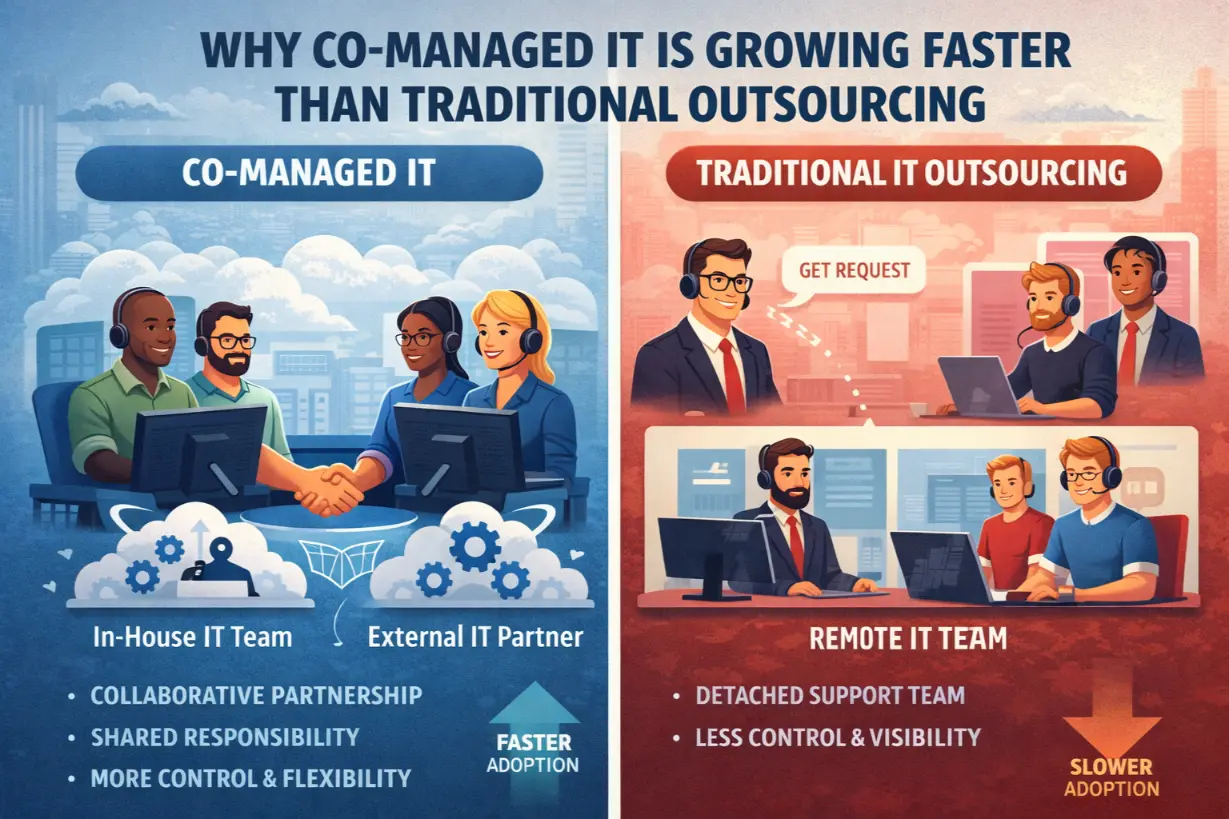
Enter co-managed IT: a hybrid model where internal IT teams and managed service providers work together, each focusing on what they do best.
This article explains why co-managed IT is growing faster than traditional outsourcing, what problems it solves, and why it’s becoming the preferred model for scaling organizations.
What Is Co-Managed IT?
Co-managed IT is a shared responsibility model where:
- Internal IT retains strategic and business-facing roles
- MSPs provide tools, monitoring, security, and escalation support
The goal is collaboration — not replacement.
Why Traditional Outsourcing No Longer Fits Everyone
Full outsourcing can create:
- Loss of internal knowledge
- Reduced control
- Cultural disconnect
Many organizations want support and scale, not abdication.
Why Internal-Only IT Is Struggling
Internal teams face:
- Talent shortages
- Burnout
- 24/7 expectations
- Increasing security demands
Even strong teams need backup.
The Market Forces Driving Co-Managed IT Growth
Increasing IT Complexity
Cloud, security, compliance, and automation demand specialization.
No single team can master everything.
Cybersecurity Pressure
Threats require:
- 24/7 monitoring
- Advanced tools
- Specialized expertise
Co-managed models provide enterprise-grade security without enterprise staffing.
Talent Retention Challenges
Replacing skilled IT staff is expensive and slow.
Co-managed IT reduces burnout and improves job satisfaction.
Business Demand for Agility
Leadership expects IT to:
- Move faster
- Support growth
- Enable innovation
Co-managed models scale instantly.
How Co-Managed IT Actually Works
Clear Role Definition
Successful co-managed IT defines:
- What internal IT owns
- What the MSP owns
- Where responsibilities overlap
Ambiguity kills collaboration.
Shared Tooling & Visibility
MSPs provide:
- Monitoring platforms
- Security tools
- Ticketing systems
Internal IT gains enterprise-grade capabilities.
Escalation & After-Hours Coverage
MSPs handle:
- Overnight monitoring
- Emergency response
- Specialized escalations
Internal teams reclaim work-life balance.
Benefits of Co-Managed IT
Scalability Without Hiring
Need more support instantly?
Co-managed IT scales on demand.
Stronger Security Posture
Advanced tools + 24/7 oversight = reduced risk.
Knowledge Retention
Internal IT stays engaged and informed.
Cost Efficiency
Businesses avoid:
- Overstaffing
- Skill redundancy
- Emergency contractor costs
Co-Managed IT vs Fully Managed IT
| Fully Managed IT | Co-Managed IT |
| MSP owns everything | Shared ownership |
| Minimal internal IT | Strong internal IT |
| Less control | More flexibility |
| Best for small teams | Best for growing teams |
Common Use Cases for Co-Managed IT
- Growing mid-market companies
- Enterprises with lean IT teams
- Highly regulated industries
- Organizations undergoing transformation
Common Co-Managed IT Mistakes
- Undefined responsibilities
- Poor communication
- Tool silos
- MSPs acting like replacements
Successful co-managed IT is intentional.
How MSPs Must Evolve for Co-Managed Success
MSPs must:
- Respect internal teams
- Provide transparency
- Share knowledge
- Support—not overshadow—staff
Partnership mindset is critical.
Cultural Fit Matters More Than Technology
Co-managed IT succeeds when:
- Trust exists
- Communication is strong
- Goals are aligned
This is a relationship, not a contract.
Co-Managed IT and Digital Transformation
Co-managed IT enables:
- Faster modernization
- Better adoption
- Reduced disruption
Internal teams drive change — MSPs support execution.
Signs Your Organization Is Ready for Co-Managed IT
- Internal IT is stretched thin
- Security demands are growing
- Leadership wants more visibility
- Hiring isn’t keeping up
These signal co-managed readiness.
The Future of IT Support Models
The future is:
- Collaborative
- Flexible
- Outcome-driven
Rigid support models won’t survive modern demands.
Co-Managed IT Is About Strength, Not Control
Co-managed IT doesn’t weaken internal teams — it empowers them.
It combines:
- Internal knowledge
- External expertise
- Scalable resources
Together, they create resilient, adaptable IT operations.
For organizations that want control and support, co-managed IT is no longer a trend — it’s the future.
Wondering if co-managed IT fits your organization?
A co-managed IT readiness assessment can determine the right balance of internal and external support.