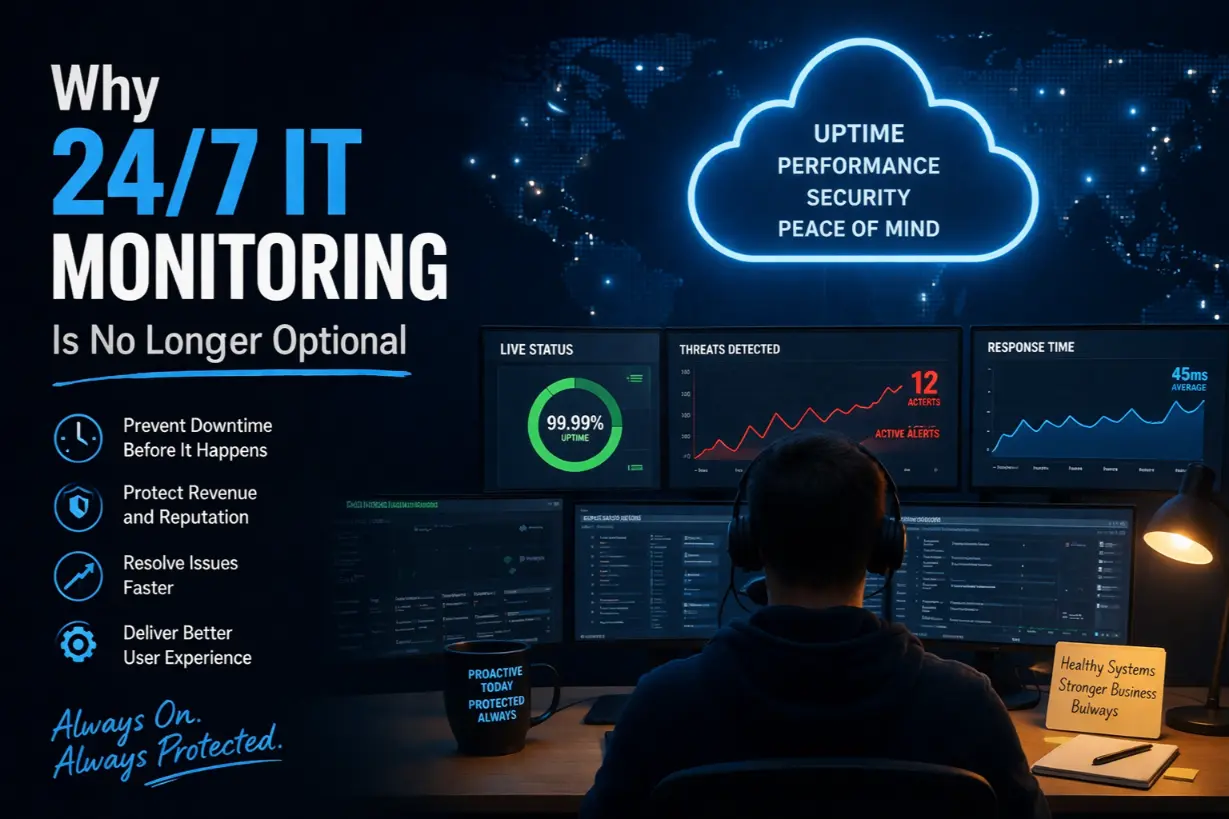
IT Problems Don’t Respect Business Hours
Most IT failures don’t wait for Monday morning.
Servers crash overnight. Security breaches happen at 2 AM. Storage fills up on weekends. Networks degrade slowly until everything grinds to a halt.
Yet many businesses still rely on business-hours-only IT oversight, creating dangerous blind spots that allow small issues to become major outages.
This article explains why 24/7 IT monitoring is no longer optional, how modern businesses rely on it for stability and security, and why managed IT services treat continuous monitoring as foundational—not optional.
What Is 24/7 IT Monitoring?
24/7 IT monitoring is the continuous, real-time observation of:
- Servers
- Networks
- Endpoints
- Cloud services
- Applications
- Security events
Monitoring systems detect anomalies, trigger alerts, and often initiate automated responses—anytime, day or night.
Why Business-Hours Monitoring Fails
Traditional monitoring models assume:
- Issues only occur during work hours
- Someone will notice problems quickly
- Recovery can wait
None of these assumptions hold true anymore.
Modern IT environments are:
- Always-on
- Cloud-connected
- Globally accessible
- Continuously targeted
Blind hours equal unmanaged risk.
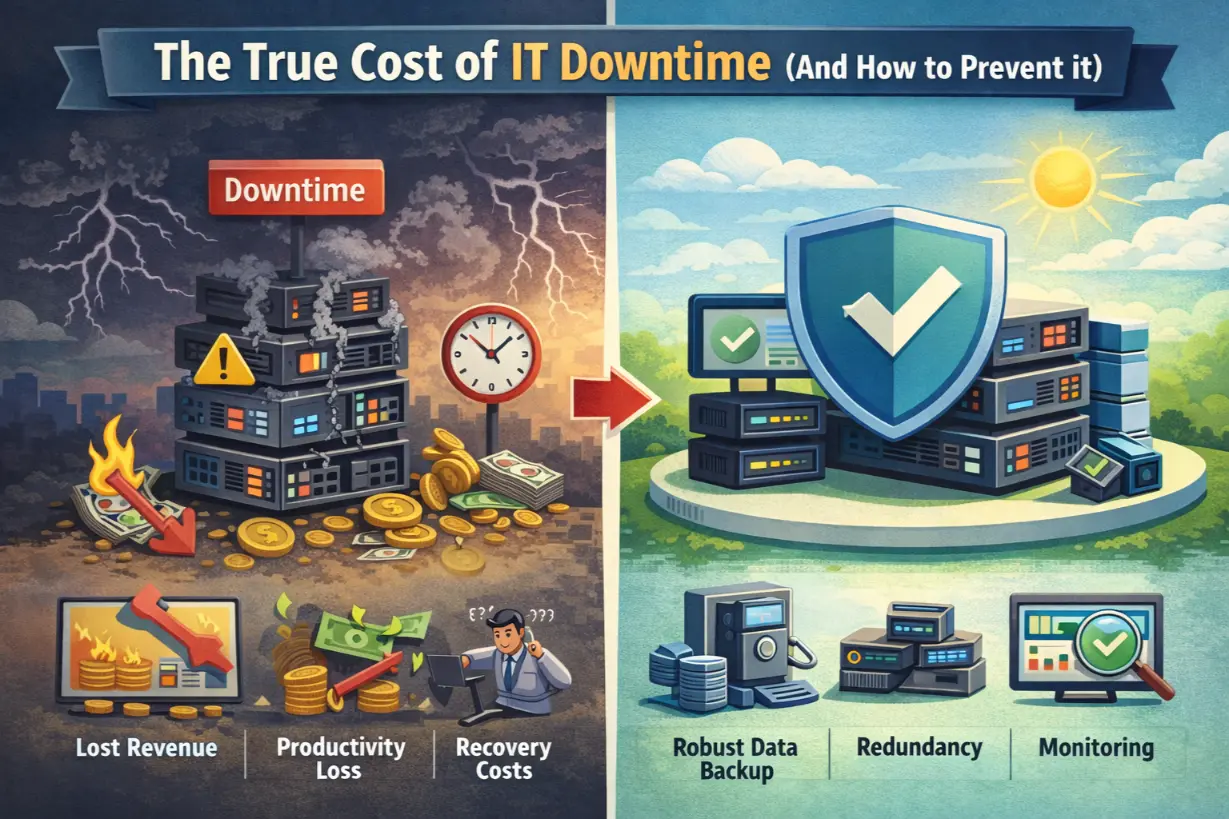
The Real Cost of Unmonitored IT Failures
Extended Downtime
When failures go unnoticed:
- Downtime lasts longer
- Root causes worsen
- Recovery becomes complex
Detection delay often matters more than repair speed.
Security Breaches Go Undetected
Most breaches are not immediately obvious.
Without 24/7 monitoring:
- Attackers persist longer
- Data exfiltration continues
- Damage multiplies
Time is the attacker’s advantage.
Data Loss Escalates
Unmonitored storage issues, failed backups, or corrupted systems often go unnoticed until recovery is impossible.
Why Modern IT Requires Continuous Visibility
Today’s environments include:
- Cloud infrastructure
- SaaS applications
- Remote endpoints
- Third-party integrations
Each adds complexity and risk.
24/7 monitoring provides a single source of truth across systems.
What MSPs Monitor Continuously
Managed IT providers monitor:
Infrastructure Health
- CPU, memory, disk usage
- Hardware failures
- Service availability
Network Performance
- Latency
- Packet loss
- Bandwidth saturation
Security Events
- Suspicious logins
- Malware behavior
- Unauthorized access attempts
Backup & Recovery Status
- Backup success/failure
- Storage integrity
- Recovery readiness
Why Alerts Alone Aren’t Enough
Alerts without action create noise.
True 24/7 monitoring includes:
- Alert triage
- Correlation
- Prioritization
- Automated remediation
MSPs don’t just receive alerts—they act on them.
The Role of Automation in 24/7 Monitoring
Automation allows MSPs to:
- Restart failed services
- Isolate compromised devices
- Resolve known issues instantly
Problems are fixed before humans even engage.
Monitoring vs Observability
Monitoring tracks known metrics.
Observability analyzes:
- Patterns
- Trends
- Anomalies
Modern MSPs combine both to predict issues before they occur.
Security Monitoring Is No Longer Optional
Cyberattacks don’t trigger obvious failures.
Continuous security monitoring detects:
- Lateral movement
- Credential misuse
- Command-and-control traffic
Without it, breaches persist silently.
Why Small Issues Become Big Outages Without Monitoring
Most major outages start as:
- Disk warnings
- Memory leaks
- Failed patches
- Network congestion
Monitoring turns early warnings into preventative action.
24/7 Monitoring and Compliance
Many compliance frameworks require:
- Continuous logging
- Event monitoring
- Incident detection
Managed IT ensures monitoring supports regulatory obligations.
Signs Your Business Lacks Adequate Monitoring
- Issues discovered by users
- Frequent “mystery outages”
- No real-time dashboards
- No overnight response capability
These indicate unmanaged risk.
Common Myths About 24/7 Monitoring
❌ “We don’t need it — we’re small”
❌ “Our systems are stable”
❌ “Cloud providers handle it”
Reality: Stability requires oversight.
The Business Value of 24/7 IT Monitoring
Continuous monitoring delivers:
- Faster resolution
- Reduced downtime
- Improved security
- Predictable operations
It protects revenue and reputation.
Monitoring Is the Foundation of Proactive IT
Without monitoring:
- Proactive maintenance is impossible
- Security is reactive
- Planning lacks data
Monitoring enables everything else.
Visibility Is Control
You can’t manage what you can’t see.
24/7 IT monitoring turns uncertainty into visibility, visibility into control, and control into resilience.
In a world where technology never sleeps, your IT oversight can’t either.
Managed IT services understand this truth — and build everything around it.
Do you know what’s happening in your IT environment right now?
A monitoring and visibility assessment can uncover blind spots before they cause outages.