Cyber Threats Move Faster Than Humans Can
Cyberattacks no longer rely on brute force or obvious malware.
Modern threats are:
- Automated
- Polymorphic
- Credential-based
- Designed to blend in
By the time a human notices something is wrong, damage is often already done.
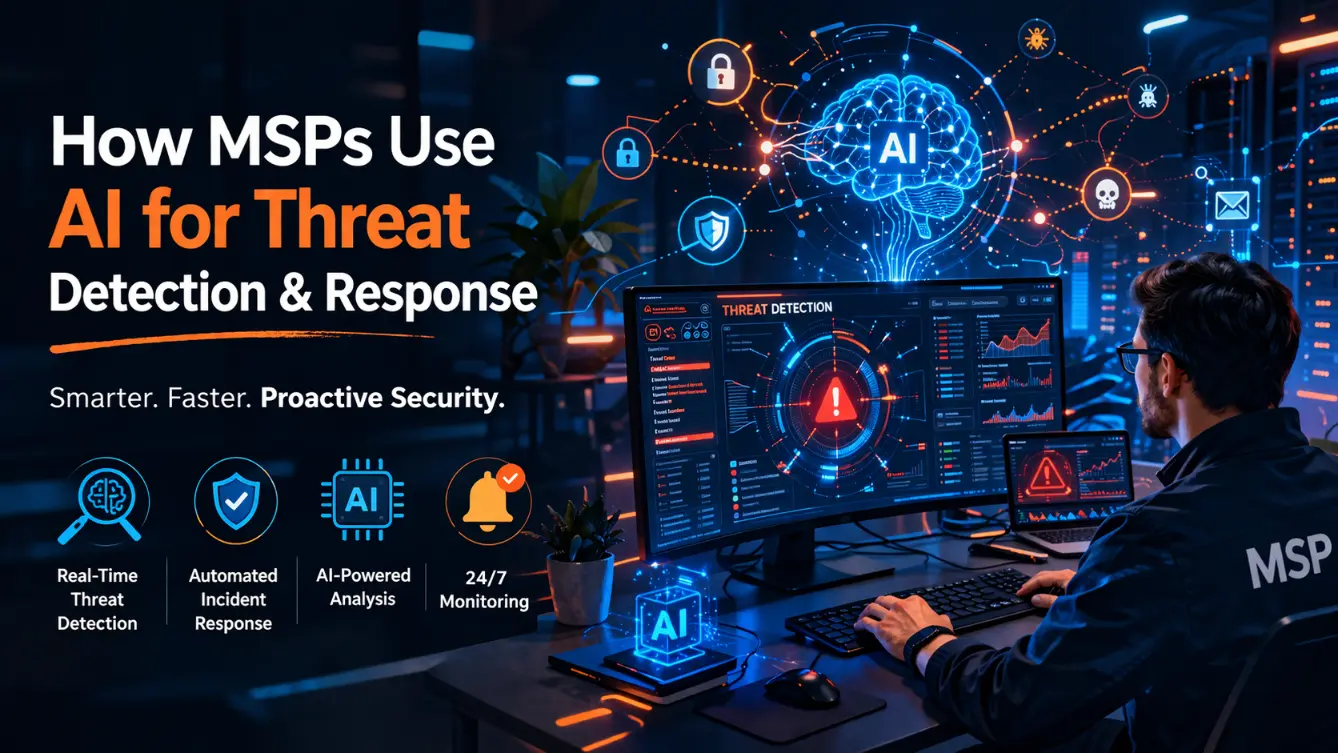
This is why artificial intelligence has become essential to modern threat detection and response. Managed Service Providers (MSPs) now rely on AI to identify subtle attack patterns, respond instantly, and reduce the time attackers spend inside networks.
This article explains how MSPs use AI for threat detection and response, and why traditional, manual security approaches can’t keep up.
Why Traditional Threat Detection Falls Short
Legacy security tools depend on:
- Known signatures
- Static rules
- Manual review
Modern attackers:
- Change behavior constantly
- Use legitimate credentials
- Exploit misconfigurations
Static defenses miss dynamic threats.
What AI Brings to Cybersecurity
AI analyzes massive volumes of data to identify:
- Behavioral anomalies
- Unusual access patterns
- Subtle deviations from normal activity
It learns continuously — improving detection over time.
Core Ways MSPs Use AI for Threat Detection
1. Behavioral Analysis (Not Signatures)
AI establishes a baseline of normal behavior:
- User logins
- Device activity
- Network traffic
When behavior deviates, AI flags it immediately.
This allows detection of:
- Zero-day attacks
- Insider threats
- Credential misuse
2. Real-Time Anomaly Detection
AI processes data streams in real time.
It identifies:
- Impossible travel logins
- Abnormal file access
- Sudden privilege escalation
Threats are detected in minutes — not days.
3. Correlation Across Systems
AI connects data from:
- Endpoints
- Email systems
- Cloud platforms
- Network logs
Individual events may look harmless — combined, they reveal attacks.
AI-Driven Threat Response: Speed Matters
Detection is only half the battle.
AI enables automated response, including:
- Isolating compromised devices
- Disabling accounts
- Blocking IP addresses
- Killing malicious processes
Response happens instantly — even at 3 AM.
Reducing Alert Fatigue With AI
Security teams are overwhelmed by alerts.
AI:
- Filters noise
- Prioritizes real threats
- Escalates only high-risk incidents
This allows human analysts to focus on what matters.
AI and Endpoint Detection & Response (EDR)
EDR platforms powered by AI:
- Detect ransomware behavior early
- Identify lateral movement
- Stop encryption processes mid-attack
Endpoints become intelligent sensors.
AI in Email & Phishing Detection
AI analyzes:
- Language patterns
- Sender behavior
- Historical communication
This allows detection of:
- Business email compromise
- Impersonation attacks
- Sophisticated phishing
Threats bypassing traditional filters are caught.
AI and Cloud Security Monitoring
Cloud environments generate enormous telemetry.
AI monitors:
- Identity usage
- API behavior
- Configuration drift
Cloud-native attacks are detected quickly.
Human + AI: The MSP Security Model
AI doesn’t replace security professionals.
MSPs combine:
- AI-driven detection
- Human threat hunting
- Expert incident response
AI handles speed. Humans handle judgment.
Why AI Is Critical for SMB Security
Small and mid-sized businesses:
- Face enterprise-level threats
- Lack enterprise security teams
AI gives SMBs access to:
- Advanced detection
- 24/7 coverage
- Automated response
Without enterprise overhead.
Common Myths About AI in Cybersecurity
❌ “AI replaces humans”
❌ “AI is only for large enterprises”
❌ “AI security is too complex”
In reality, AI makes security more accessible and effective.
Risks of Not Using AI in Threat Detection
Organizations without AI face:
- Slower detection
- Longer dwell time
- Higher breach costs
- Missed subtle attacks
Attackers already use automation — defenders must match it.
How MSPs Evaluate and Tune AI Security Tools
MSPs:
- Continuously tune models
- Validate detections
- Adjust response thresholds
- Test incident scenarios
AI is monitored just like any system.
The Future of AI-Driven Security Operations
Expect:
- Self-learning defenses
- Autonomous response playbooks
- Predictive threat modeling
- Reduced breach impact
Security operations will become faster and smarter.
Signs Your Security Stack Lacks AI Capabilities
- Signature-only antivirus
- High false positives
- Manual incident response
- Slow detection
These indicate outdated defenses.
AI Levels the Security Playing Field
Cybercriminals already use automation and AI.
Businesses that rely on manual, reactive security fall behind immediately.
Managed IT providers leverage AI to:
- Detect threats earlier
- Respond faster
- Reduce damage
- Protect businesses continuously
AI doesn’t just improve security — it makes modern security possible.
Unsure if your security tools can detect modern threats?
An AI-driven security assessment can reveal detection gaps before attackers exploit them.