Deals Fail When IT Is an Afterthought
Mergers and acquisitions look great on paper.
Revenue grows. Market share expands. Talent is acquired. Synergies are promised.
But many deals stumble — or fail outright — not because of strategy or finance, but because technology integration is mishandled.
IT systems determine:
- Operational continuity
- Data access
- Security posture
- Employee productivity
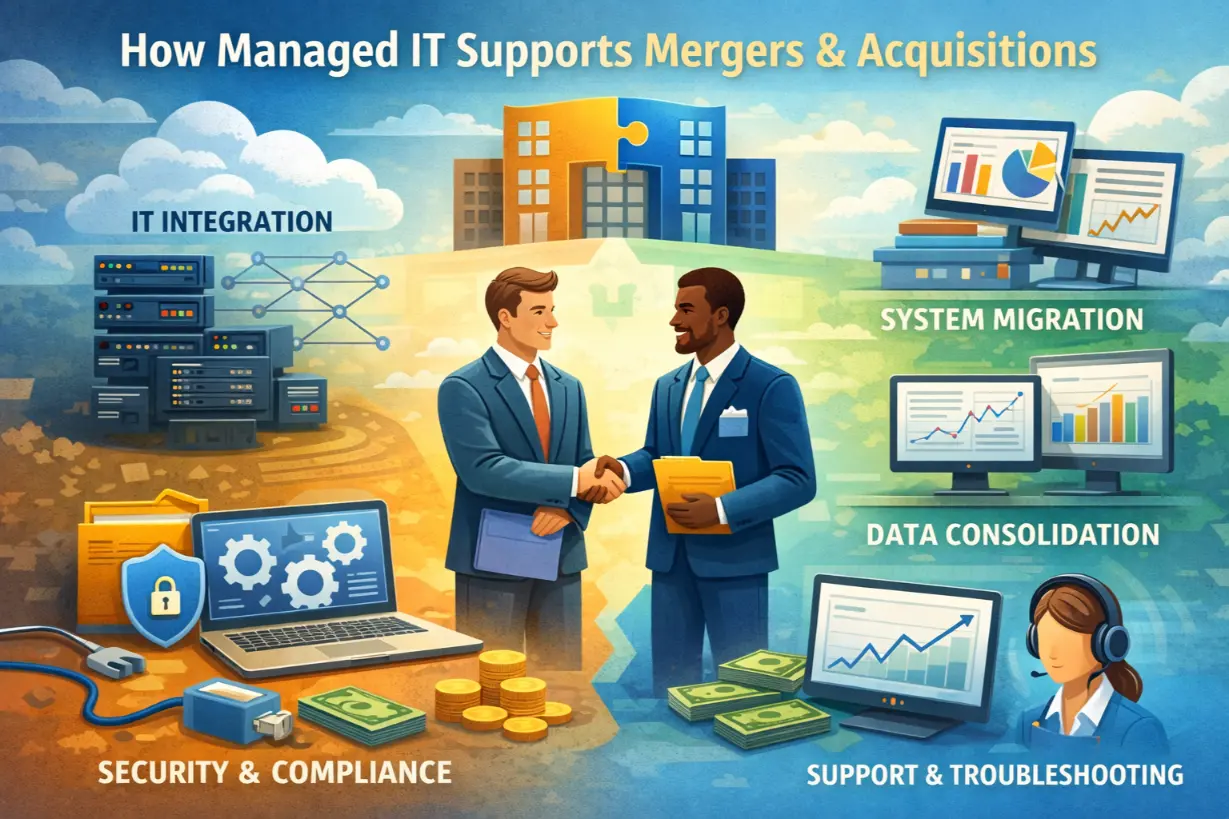
This article explains how managed IT supports mergers and acquisitions, reduces hidden risk, and ensures technology accelerates — rather than undermines — deal success.
Why IT Is Critical in M&A
Technology touches every part of the deal:
- Financial systems
- Customer data
- Intellectual property
- Security controls
- Compliance obligations
Ignoring IT risk is equivalent to ignoring financial risk.
The Biggest IT Risks in Mergers & Acquisitions
Hidden Security Vulnerabilities
Acquired companies often have:
- Weak security controls
- Outdated systems
- Poor monitoring
These vulnerabilities become yours instantly.
Data Integration Challenges
Incompatible systems lead to:
- Data silos
- Manual workarounds
- Reporting failures
Poor integration slows synergy realization.
Downtime During Transition
Unplanned migrations cause:
- System outages
- Lost productivity
- Customer disruption
Downtime erodes deal value.
Compliance & Legal Exposure
Different environments may violate:
- HIPAA
- PCI-DSS
- SOC 2
Post-acquisition compliance failures are costly.
Phase 1: Pre-Acquisition IT Due Diligence
Managed IT plays a critical role before the deal closes.
Assessing the IT Environment
MSPs evaluate:
- Infrastructure health
- Security posture
- Backup and recovery
- Cloud usage
- Licensing risks
This uncovers hidden liabilities.
Identifying Integration Complexity
Due diligence reveals:
- Application overlap
- Dependency risks
- Network incompatibilities
Complexity affects timeline and cost.
Quantifying IT Risk
Managed IT translates technical gaps into:
- Cost estimates
- Timeline impacts
- Risk exposure
Leadership can make informed decisions.
Phase 2: Integration Planning
Developing an IT Integration Roadmap
MSPs build plans for:
- System consolidation
- User access
- Data migration
- Security alignment
Integration is phased — not rushed.
Security Alignment & Risk Containment
Before connecting networks:
- Security controls are aligned
- Access is restricted
- Monitoring is enforced
This prevents risk propagation.
Phase 3: Post-Merger Integration Execution
Identity & Access Management
Managed IT ensures:
- Unified identity systems
- Role-based access
- Secure onboarding/offboarding
Access chaos is avoided.
Application & Data Integration
MSPs manage:
- Data migration
- System consolidation
- Legacy system retirement
Business operations remain uninterrupted.
Standardizing IT Operations
Post-merger stability requires:
- Standard device configurations
- Unified monitoring
- Centralized support
Consistency restores productivity quickly.
How Managed IT Reduces M&A Downtime
Managed IT provides:
- Parallel environments
- Phased cutovers
- Rollback plans
Transitions are controlled — not disruptive.
M&A and Cybersecurity Risk
M&A increases attack surface dramatically.
Attackers target:
- Integration chaos
- Temporary access gaps
- Newly connected networks
Managed IT ensures continuous security coverage.
The Role of Managed IT in Private Equity
Private equity firms rely on managed IT to:
- Standardize portfolio companies
- Reduce operational risk
- Accelerate exit readiness
IT maturity increases valuation.
Common IT Mistakes in M&A
- Connecting networks too early
- Ignoring legacy security gaps
- Underestimating integration timelines
- No centralized oversight
These mistakes destroy value fast.
How Managed IT Protects Deal Value
Managed IT:
- Prevents data loss
- Reduces downtime
- Controls security risk
- Supports rapid integration
Value is preserved — and enhanced.
M&A Success Depends on IT Transparency
Executives need visibility into:
- System status
- Risk exposure
- Integration progress
Managed IT delivers clear reporting.
Signs IT Is Undermining Your M&A Strategy
- Unexpected outages
- Security incidents
- Employee frustration
- Integration delays
These are warning signs.
IT as an M&A Enabler, Not an Obstacle
When managed correctly:
- IT accelerates synergies
- Improves scalability
- Enhances security
Technology becomes a growth engine.
No Deal Succeeds Without IT Alignment
Mergers and acquisitions are complex enough without IT surprises.
Managed IT ensures:
- Risks are identified early
- Integrations are structured
- Operations remain stable
- Security is never compromised
When IT is planned, M&A succeeds faster — and with far less friction.
Planning an acquisition or merger?
An IT due diligence and integration assessment can identify risks before they impact deal value.