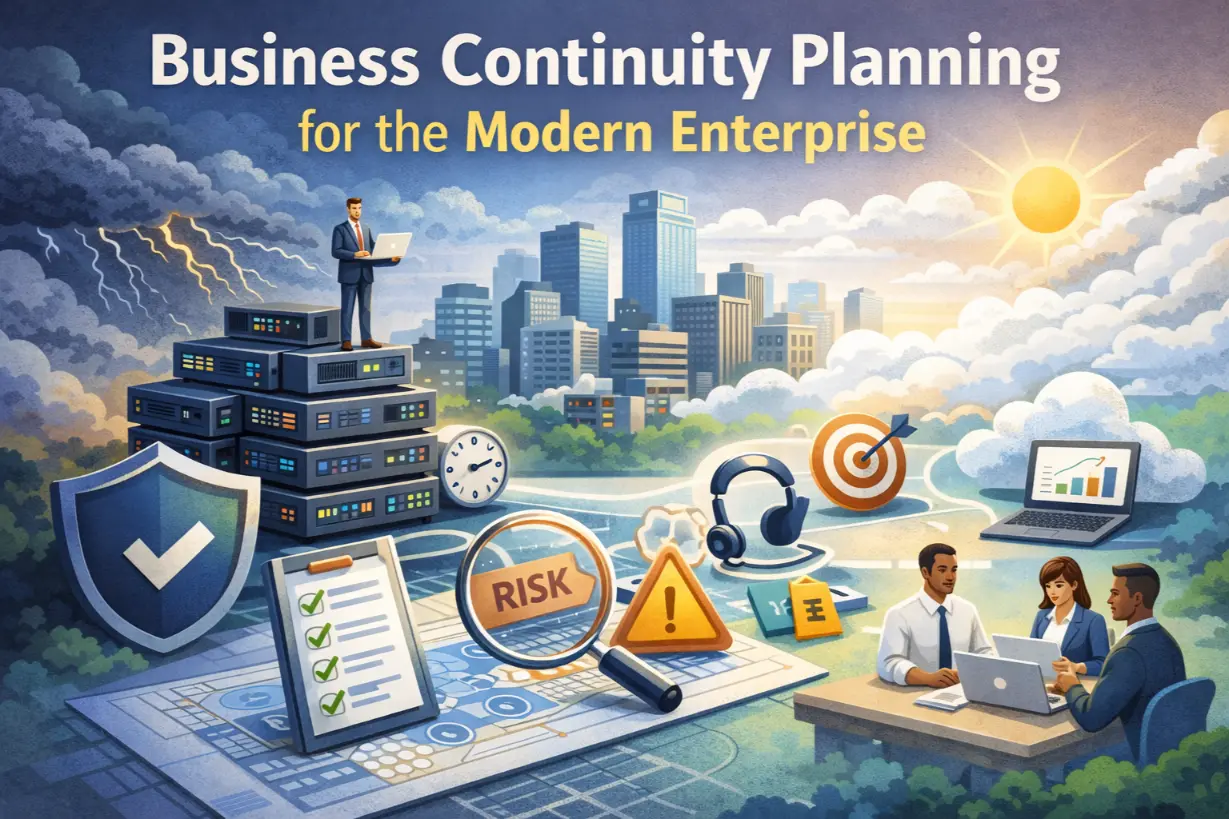
Disruption Is No Longer a “What If”
For years, business continuity planning was treated as a worst-case exercise.
Something you did:
- For compliance
- For audits
- For “just in case” scenarios
Today, disruption is not hypothetical.
Cyberattacks. Cloud outages. Supply chain failures. Power loss. Extreme weather. Human error. Vendor failures.
The question is no longer if disruption will occur — it’s how prepared the business is when it does.
This article explains business continuity planning for the modern enterprise, why legacy approaches fall short, and how managed IT services turn continuity from paperwork into operational resilience.
What Is Business Continuity Planning (BCP)?
Business continuity planning ensures the organization can:
- Continue critical operations
- Minimize downtime
- Protect data
- Serve customers
- Recover quickly
During and after disruptive events.
BCP is about keeping the business running, not just restoring systems.
Why Traditional BCP No Longer Works
Legacy BCP assumed:
- On-prem systems
- Centralized offices
- Limited threat vectors
Modern enterprises operate with:
- Cloud-based systems
- Remote workforces
- Always-on digital services
- Constant cyber threats
Continuity plans must evolve with reality.
The Real Cost of Poor Business Continuity
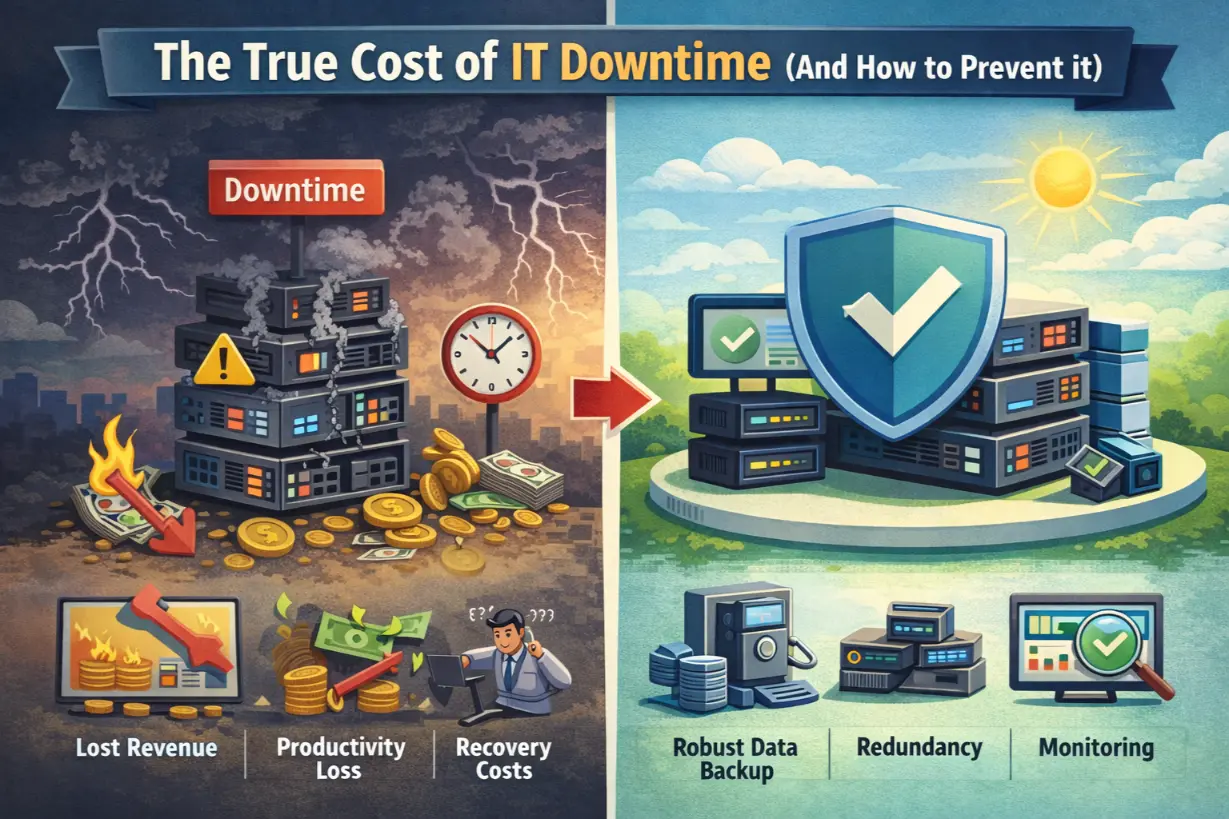
Inadequate continuity planning leads to:
- Revenue loss
- Customer churn
- Regulatory exposure
- Brand damage
- Employee chaos
Downtime is no longer just inconvenient — it’s existential.
Core Components of Modern Business Continuity Planning
1. Business Impact Analysis (BIA)
BCP starts with understanding impact.
A BIA identifies:
- Critical business functions
- Revenue dependencies
- Acceptable downtime
- Data loss tolerance
Not all systems matter equally.
2. Defining RTO and RPO
Modern continuity planning requires clarity.
- RTO (Recovery Time Objective): How long can systems be down?
- RPO (Recovery Point Objective): How much data loss is acceptable?
These metrics guide investment and strategy.
3. IT Infrastructure Resilience
Continuity depends on:
- Redundant systems
- Cloud failover
- Reliable backups
- Network resilience
Managed IT ensures infrastructure supports continuity goals.
4. Cyber Resilience
Cyber incidents are now the top cause of disruption.
BCP must address:
- Ransomware recovery
- Account compromise
- Data integrity
- Incident containment
Security and continuity are inseparable.
5. Workforce Continuity
Employees must be able to work during disruption.
This includes:
- Secure remote access
- Device availability
- Communication channels
People continuity matters as much as system continuity.
Why IT Is Central to Business Continuity
Every critical business function relies on IT.
Email. ERP. CRM. Finance. Operations. Customer support.
If IT fails, the business stops.
Managed IT ensures:
- Technology aligns with continuity objectives
- Recovery is tested
- Dependencies are documented
The Role of Managed IT in Business Continuity
Managed IT transforms BCP from theory into execution.
Proactive Risk Identification
MSPs identify:
- Single points of failure
- Aging infrastructure
- Security gaps
Risks are addressed before disruption.
Tested Backup & Recovery
Backups are:
- Automated
- Monitored
- Tested regularly
Recovery is proven — not assumed.
Continuous Monitoring
24/7 monitoring detects:
- Early warning signs
- Performance degradation
- Security incidents
Response begins immediately.
Crisis Response Coordination
During incidents, MSPs:
- Execute recovery plans
- Communicate status
- Escalate appropriately
Calm replaces chaos.
Business Continuity vs Disaster Recovery
Disaster recovery focuses on:
- Restoring systems
Business continuity focuses on:
- Continuing operations
Recovery is a component of continuity — not the whole plan.
Cloud and Business Continuity
Cloud enables:
- Geographic redundancy
- Rapid recovery
- Flexible scaling
But only with proper architecture and governance.
Common Business Continuity Mistakes
- Treating BCP as an IT-only task
- No testing
- Outdated plans
- Ignoring cyber threats
- Assuming vendors handle continuity
Assumptions fail under pressure.
Business Continuity and Compliance
Many regulations require:
- Documented continuity plans
- Tested recovery
- Incident response procedures
Managed IT helps meet and maintain these standards.
How Often Should Business Continuity Plans Be Reviewed?
At minimum:
- Annually
- After major changes
- After incidents
Continuity plans must evolve with the business.
Signs Your Business Continuity Plan Is Weak
- Recovery depends on one person
- Plans haven’t been tested
- Employees don’t know procedures
- No cyber incident planning
These are critical vulnerabilities.
Business Continuity as a Competitive Advantage
Organizations with strong continuity:
- Recover faster
- Retain customers
- Protect revenue
- Inspire confidence
Resilience builds trust.
Leadership’s Role in Continuity Planning
BCP is not just an IT document.
Leadership must:
- Set priorities
- Approve recovery objectives
- Support testing and investment
Continuity reflects leadership maturity.
Resilience Is the New Stability
Stability assumes nothing goes wrong.
Resilience assumes something will — and prepares accordingly.
Modern enterprises don’t just survive disruption — they absorb it, respond, and continue operating.
Managed IT services ensure business continuity planning is:
- Practical
- Tested
- Aligned with real-world threats
When disruption hits, resilience determines who recovers — and who doesn’t.
Not sure if your business could operate during a major disruption?
A business continuity readiness assessment can identify gaps before a crisis exposes them.